Showing posts with label storage. Show all posts

Wednesday, September 23, 2020

Painted Desert, But Not the Real One

 It is done.  A full table of desert terrain.

Primed and ready for color

But not too much color - it is a desert after all.

Chicken Joe showing off some big rocks.

A small camp near the dunes and columns.

Hiding behind a small dune.

Deep in the shade during the heat of the day

Easy storage for the down time.


Saturday, February 10, 2018

Wrap It, Stack It...

Smack it on the bing-bong!  The four fantasy boxes are done.
Four mounted troops, three big bossmen, thirty-five infantry, and a cute little doggo.  If you can't field a good four skirmish forces out of that mix, you're in the wrong hobby, buddy.

This aerial shot shows how well the different basing colors work to help distinguish one troop type from another.  From left to right we're looking at humanoids (brown/yellow), undeadish (black), elves (dark green), and heroes (white).

Boxed up in tubs two-inches by three-inches, lined with a bit of scrap foam, they are ready for transport.  Being a cheap friend, they'll go by slow boat, and two of them are headed half-way across one pond, across a continent, and then across another pond.

It might be a while before they see the table in a competitive way.

On to the next project!

Wonder what it will be...

Thursday, January 18, 2018

End of the Box

To fantasy up the four small wargame boxes, I needed something with a touch of magic.  Hence four wizard towers.  Yeah, they all look a little different.  So do the ponds and the houses and the woods.  And most of the figures.  It's nice - they all have that personal touch that turns this from another boxed game to a personalized gift from a friend.


So that's a total of eight terrain items and fifteen inches of hedges.  Not a bad little setup.  The really nice thing about this setup is that the colors are so garish.  That sounds odd until you consider the purpose of the setup.  Visual appeal might be everything, but this set will be shown via lo-res webcam, so to keep things straight, the pieces really need to jump off the battlemat.  For the terrain, the water is bright, the tower has red splashes, the house is a bright yellow, and the forest has that nice dark shadow.  When used for actual play, it will be a lot easier to recognize these pieces that if I had made the usual attempt to closely match ground color to terrain base color.

Of course, now I'm starting to wonder if my figures
are going to show up at all.  Something to consider...
And here it all is boxed up and ready for storage.  The figures are stuffed in a plastic box under the broken ground.  With a drop cloth and a little bit of newspaper, this bad boy should make it half way around the world with no problems.

Friday, January 12, 2018

Four by Twenty Figures

Last post I showed you my current project's status.  For those new to Chateau Abox, I'm building four identical game sets, so that I can do some online wargaming with a tactical component.  If you ain't pushing lead, you ain't miniature wargaming, after all.  By using 10mm figures already in hand, and not already in use, I was able to put together a fun little set.

 
This all fits inside a small shoebox sized plastic tub, along with the figures:
 
Opening up the blue-handled box, we see the small host of random figures:
Which parts out to a 5-man adventuring party, two ogres with four orc slaves, a minotaur and his three man dog-head retinue, and five skeleton warriors.  Not bad, but needs more Dakka.  I've got another 40 figures per box on order from Irregular that will really round this out and make this box sing.  You'll see.
One thing to point out is that the adventuring parties all consist of a wizard, an elf, a sword and board human, a dwarf axeman, and a hobbit.  They aren't the same fighters, they aren't the same elfs, and they definitely aren't the same wizards.  For example, one wizard is basically Gandalf and another a fire-wizard, and the one shown is more necromancer than anything else. Eh, close enough for 10mm figures shot on camera, right?  This whole thing is a little more abstract than is my usual wont.
That said, I'll have to make sure my planned wizard towers match the figures.  Did I mention the wizard towers?  Oh yeah, we need some serious fantasy terrain to really make this special, and we're going to get 'em.

Thursday, December 29, 2016

The Compleat Castle Meatgrinder

Who are we kidding? A project like this is never complete, it just goes into hibernation. As we round out the year of fantasy skirmish here at War In A Box, let's take a look at where the project stands. At the current time we've got over 50 characters in four different races for player pawns.  We've got at least a dozen each of orcs, ratmen, lizardmen, undead, cultists, and frogmen.  We've got creatures from vermin to ogres, flying things, climbing things, swinging things, and tentacled things.  We've got traps galore and puzzles to boot.  As it stands Castle Meatgrinder spans ten dungeon levels, each with ten to fifteen rooms, and a few hidey-holes to allow for future expansions.

That's a lot of stuff, but in keeping with the mission of compact gaming on a budget, let's take a look at how compact you can make a D&D megadungeon if you're willing to game in 15mm.

Every figure in the fantasy collection.
 
With room for another faction/warband in the case.

The plastic tub contains all of the dungeon floor tiles, and the Old Spice box contains the delicate dungeon dressing.  To give you a better idea of scale, that tub is designed to carry two reams of standard sized paper.

You won't have any trouble carrying this mega-dungeon around a crowded convention hall.

So what are we missing?  A few things:
  • Natural caverns.  There's room for a few more halls and rooms in the tub.
  • Big beasts.  We don't have a dragon or giant or any number of high-level threats.  Right now it's all strictly low level gaming.  Aside from a few minotaurs, we don't even have any of the heavy-hitting humanoids.
  • The Old Spice box is pretty empty.  We can add a lot more dungeon dressing to it, or maybe find a better carrier so that all of the dungeon materials themselves are in a single box.

Thursday, April 7, 2016

Temporary Storage Solution

One of my Christmas gifts to myself was this great box.  It had personal hygiene products in it, but I'm a gamer, so did what gamers do and threw that in the garbage.  This box, though.  Sliding top, solid wood, pretty swanky.  At some point I will need to create some inner partitions, but I'm waiting until I get more dungeon terrain done.  
It'll be a lot easier to figure out what size compartments I need once I know what all needs to go in there.  At this point we are up to:


  • Wizard library
  • Wizard laboratory
  • Bunkroom
  • Dining Hall
  • Mystic Garden
  • Hall of the Blood Columns
  • The Well
  • The Glowing Angelic Statue
  • The Stone Tree
  • The Pool Room
  • Lone Mirror Room
  • Black Altar of Death

  • That's a pretty good dungeon, but now...we need some traps!

    Friday, January 8, 2016

    Small Box Blues, Part Five

    Over the course of the week we have been looking at a number of different strategies to maximize the gamable space that you can fit into a small storage box.  As promised, today presents my own solution to the vexing problem of making a sci-fi interior battlefield with attractive walls, easy access, and widely variable floorplans.  And here it is:

    Quit.

    You know, when you get right down to it, my sci-fi battlefield isn't even done yet. Even with the ad boxes and tree planters that I showed you last week, it still needs some vending machines, more vehicles, a solar farm, telecommunications arrays, more planter boxes, and maybe some benches.  That's a lot of work to do while simultaneously working on a whole new set of interiors.  Starting a whole new terrain set when your last one isn't done would be the work of either a maniac, idiot, or wargamer.  Fortunately, I am equal parts each.

    It's been long enough that I've delayed upgrading my fantasy figures to God's Own Scale.  My last purchase included a bunch of heroes and skeletons.  Not many, but enough to build a warband or two.  Before they take the field, we're going to need a field.  And that fantasy field is my solution to the Big Box Blues: Castle Meatgrinder!

    The ground level of Castle Meatgrinder, Take One.
    The first step always looks a bit rough.  To give you an idea
    of scale, the rectangles are the size of a standard sheet of paper.
    This is going to be a fairly substantial process, with a lot of trail and error.  Hopefully, you lot can learn from my trials, and not make my errors.  Before we get too far down the road, though, I'll have to clear some space from my workbench, so expect a week or so of sci-fi scatter terrain, and then we'll come back to the Castle.

    Thursday, January 7, 2016

    Small Box Blues, Part Four

    There's no way around it - big multi-layer pieces of terrain just aren't going to fit into a small box. So let's just stick with a one level floor plan. Everybody and his uncle uses some variation of rectangular or hex-based tiles for their terrain.  But since this is sci-fi, and we're building space-stations and spaceports and such, we should look for something a little more scientific.  So how about a nice repeating pentagon pattern?

    These mock-ups of tiles are based on a repeating regular polygon pattern called a Cairo Tessellation. The pentagon has four equal sides and a fifth, longer side.  Two of the angles are right angles, so you could combine this pattern with square tiles to get some very interesting results.

    The green lines are an experiment in wall placement.  If you put doorways at the center of each side, then you can be assured that everything lines up.  Leave one or two sidewalls completely open and you can easily build large chambers, too.

    I abandoned this idea when it became obvious that you're going to have to sacrifice too much  gameable space in the box.  Remember that my box limits me to roughly three stories worth of tiles, and I'd only get three large or six small tiles total.  That's just not enough to satisfy me.  I could stack them on their sides and fit seven or eight, but each one would be even smaller than the ones shown here.  That still leaves a lot to be desired.


    Tune in tomorrow for the thrilling conclusion and solution to the Small Box Blues!

    Wednesday, January 6, 2016

    Small Box Blues, Part Three

    Last time we looked at a few ways that smart people approach the challenge of cramming as much terrain into a small space as possible.  This time let's look at how a dumb person does it.  And by dumb person, I mean me.

    In addition to cramming as much terrain as possible into a single small box, I also wanted to incorporate something that all of the last post's featured bloggers did not - the third dimension.  I want some height.  Both for visual appeal and for added gaming possibilities.  I want snipers and ladders, and ways to go over terrain and not just around it.


     My first attempt consisted of constructing two L-shaped buildings three floors in height.  These could be packed in to the big box side by side giving me two large end-pieces for a gray drop cloth.  Add some stairs, and a bunch of shopping kiosks, and you've got a nice little starport.

    You put one of these in each corner, or even adjacent to each other, and  now you're talking.  The downside to this plan is that my fat fingers can't fumble back into the back corner.  With only six inches of head space, each floor is only two inches high.  You can get away with narrow corridors, but a full balcony just won't work well in practice.

    Also, I mis-measured my pieces, and couldn't fit them both in the box at the same time.
    At least I checked before going too far down this
    dead end.
    Cut that down by a couple of inches to make them square?  Bah!  Too much work for too little reward.  Besides, they would fill the box.  By the time the stairs and a couple kiosks are done, all I'd be left with is some small scatter terrain.

    Next, I experimented with large one-story tiles, to see if there was a way to pack eight tiles with walls into the box.  There was a way to nest them resulting in a battlefield the size of 8 sheets of paper, but everything wound up really short and crammed into the box in a way that was guaranteed to damage the terrain.  There was still no room left for any sort of scatter-terrain.

    Perhaps it was time for something really different?  Next time we'll look at a more Escher-esque attempt at the small box...

    Tuesday, January 5, 2016

    Small Box Blues, Part Two

    There are basically two ways to build wargame interiors.  You can place freestanding walls on a ground surface (aka "the maze"), or you can integrate them into the ground surface (aka "tiling"). There is a third way, a hybrid method with tiles that represent rooms and corridors.  Let's look at each in turn.

    The maze gives you a lot of flexibility at the cost of visual appeal.  The walls are left generic so that they can represent anything; any specific feature that draws attention to the purpose of the room limits your flexibility.  Furniture scatter terrain serves that purpose.  A stove marks the galley, a bed marks the bunk, and a command chair marks the bridge.  A standard assumption of the maze is that the perimeter of the drop cloth actually represents invisible walls.

    In practice, there is little to distinguish the maze from an outdoor setup.  You've got a rectangular battlefield with large terrain pieces scattered about that influence your decision making process.  The terrain may be linear walls instead of blobby buildings and woods, but you're still playing on a plane surface broken by impassable terrain.

    Tiling gives you the ability to designate spaces by purpose.  Now, in addition to the stove, you've got a menu and cabinets line the walls, and the command chair faces large viewing portholes.  You get a much more appealing look at the cost of flexibility.  You also gain fully visible exterior walls, further marking the gamable space as firmly "inside".

    A tiled battlefield feels very different from the maze.  It's more claustrophobic as everywhere you turn, there's another wall.  You wind up thinking more in line with real world interiors ("Better send three guys through the garage bay to flank them through that dining hall.") than you do with a maze.  The game play might be similar, but having real world features helps turn things from a gladiator arena to a living space.  It changes both the aesthetic and the game play.

    So if you're looking for an actual interior, it's well worth it to create actual tiles.  Which would bring us back to my new box set, but before we do that, let's look at a couple of cool hybrid strategies implemented by other bloggers.

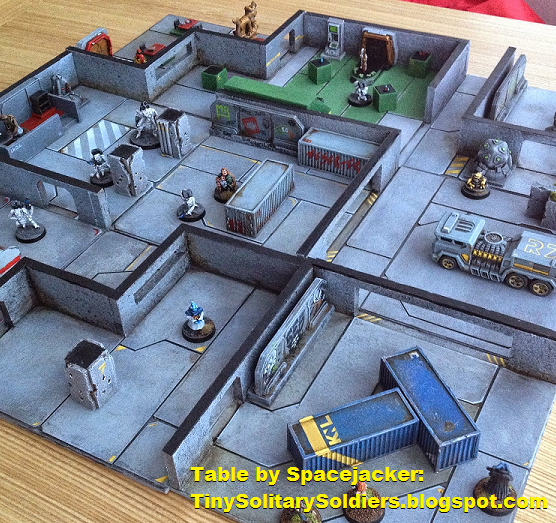
    Spacejacker built a blank tile set with themed scatter terrain.  It's an elegant solution which allows for a lot of flexibility, while capturing the interior feel.

    Delta Vector's solution was to build individual rooms, but place them on top of a drop cloth.  Those corridors still look and feel like an interior, but he can personalize each room.  Plus, gains the stackability of the rooms, allowing him to pack more terrain into a smaller box.  Again, a very clever technique.

    Stalker7 built a maze on top of tiles.

    There are a lot more clever ideas out there, but that gives you some idea for how smart people approach this situation.  Next time we'll look at how a dumb person does it.

    Monday, January 4, 2016

    Small Box Blues, Part One

    How do you cram as much gamable space as possible into as small a space as possible?  We're going to kick 2016 off with a week-long series of posts introducing my solution to one specific kind of terrain.  Specifically, a solid set of sci-fi interiors that are attractive, provide a wide variety of battlefields, and allow room to reach the figures.  First though, let's establish what we mean by gamable space.

    Any place that a figure can move to or shoot through is part of the gamable space.  The most common limits to gamable space are marked by the edge of a ground cloth, which can be fabric, foam, or even the edge of the table.  Sometimes we limit gamable space within those out boundaries by placing 'no-go' areas like the space between halls and rooms in a dungeon or space hulk, or impassable terrain like mountains or un-scalable buildings.  If the game can't go there, it isn't gamable space.

    That is a central concept so tied into the game that we never really think about it beyond answering the questions of how much space do you need, and what happens when a figure leaves that space. It takes on significantly more import when you are trying to get as much of that space into as little storage space as possible.  And that's the subject of today's post.

    The arbitrary and artificial limitation that I have placed on my gaming, that a full set of terrain must fit inside a smallish box, makes things challenging.  Gaming primarily in 15-mm skirmish settings eases that pain a bit; you only need to build up enough terrain to cover two- to three- foot squares of real estate.  That still leaves you with a situation where space inside the storage box is at a premium.

    One solution to this are as old as gaming itself.  Namely, throw in a drop cloth of the right size and five to ten pieces of scatter terrain such as buildings, roads, forests, and hills.  It works great - you get a big space with a lot of variation with very little space investment.  I took this classic approach with the first big box set.

    I don't think I've ever showed how my sci-fi battlefield
    all packs up into one small box.

    Even with the dedicated roadways limiting terrain placement, there are still countless ways to vary the setup.  You can even block those long firing lanes with appropriate scatter terrain such as vehicles, concrete traffic barriers, and makeshift barricades.  The possibilities are limitless.  With a ground cloth that is roughly two- by three- feet across, you always get six square feet of battlefield.


    That box is roughly 6 by 8 by 10 inches
    For my next set of terrain, I bought a the storage box manufactured to hold two sheaves of writing paper.  As a result the box measures eleven by nine inches with a height of six inches.  It's a little bigger than that, actually, but we need some wiggle room lest we damage the terrain in storage.  So let's consider the floor to be about two-thirds of a square foot (99-square inches) of real estate.

    The theme of this next terrain set would not consist of another outdoor drop cloth setup - we already have one of those.  This time around would be an interior setup, or at least something similar.  The challenge with interior setups is that pesky third dimension.  Now you have to consider how tall to build your walls, and that limits the horizontal space.  You can fold up a drop cloth and cover up to twelve box footprints (eight square feet of battlefield) in just an inch or two of vertical space, with plenty of space left over for set-piece and scatter terrain.  If your interior tiles have walls an inch high, you can only fit six tiles (four square feet of battlefield) with no room left over.

    My initial thought was to build a series of nesting rooftops.  Back in early November I shared a couple of photos of the first phase of my new box set of terrain. By nesting the rooftops inside each other, you're looking at four pieces of terrain, each about nine by eleven, that fit together to give you about 2.75 square feet of gamable space.  You can extend that a little by not butting each right up against each other.  The alleys between are still gamable - you can shoot or even leap over them - but now you've got four islands and a lot fewer lanes for movement.  Goodbye flexibility, hello overwatch!

    We can do better.  But how?

    Tomorrow we'll look at some possible solutions, including a few clever ideas from my fellow wargame bloggers.

    Wednesday, October 14, 2015

    The Complete One Hour Wargame

    What with one thing and another, it occurred to me that you've never seen the medieval Big Box in all its compact wargame glory.  

    One complete wargame
     As you can see, the Big Box contains the following:
    • A three foot by three foot ground covering cloth
    • One large forest and one small forest
    • A farmstead with associated walled field
    • A large hill and a small hill
    • One small pond
    • One rocky base representing rough ground
    • Sixty inches of roadway not including the crossroads
    • Sixty-eight inches of river including two fords and one bridge
    • Two complete 10 stand armies in the 6-mm scale
    That's everything you need to make any one of the 30 battlefields shown in the scenario chapter of the One Hour Wargame rulebook.  You could easily use this setup for just about any of the rule sets included in the book, too.  Granted, you may want to swap out the farmstead for something more technologically or geographically appropriate (i.e. a clapboard church for the American Civil War or a petrol station for WWII), but that should be easy enough to do while building another matched set of armies.

    When the battle is done, the whole setup fits into a box small enough to fit into the overhead carry-on compartment of your standard passenger aircraft.
    All packed away for the night.
    It might not be as glorious as some of the Infinity setups you see floating around on the net or have as many figures as a Featherstone participation game, but it's enough to scratch the wargaming itch, and you don't need a lot of scratch or space to put the whole box together.  As usual, the figures are the expensive part, and if you go with an outfit like Irregular Miniatures you can get each army for somewhere around sixty bucks.  That means this whole game costs less than half of an army for many of the Big Box game companies.

    Friday, January 16, 2015

    Big Box Terrain, Part Five

    Reality check!  Now that the new box has a nice selection of terrain, it's time to verify that the terrain will fit into the box with room left over for the armies.  The armies aren't here yet, so I cut some rough bases out of paper to see how everything would fit together.
    Right.  So.  Those "bases" are two by three inches, or about sixty square inches.  As you can see, one army of ten bases will fill about two-thirds of a blue box.   There isn't enough room to fit both woods, the pond, hills and rough ground into one box, so things are already getting tight, and we haven't even built up the built-up area (read: village (read: in 6mm a village means one or two houses on a ) base).  We can stack some terrain on top of the drop cloth like so:


    But we've also got nine feet of linear terrain to assemble in the form of six feet of road and three feet of river.  I had hoped to toss those on top of the drop cloth.  Might have to put the linear features under the drop cloth, and the woods or something on top.  We'll see.

    The larger lesson learned here is that the One Box to Rule Them All doesn't have much room left for fancy dancy terrain features.  I'll have to finish off the basics and armies before doing something silly like a wizard's tower or magic circle of standing stones.  The good new is that it looks like there's room for a second drop cloth in the box.  I may just try my hand at painting up a 'fields and meadows' drop cloth like the ones done by Small World Productions.

    Not mine!  Click for the awesome source
    That drop cloth is canvas covered by caulk and sand.  That's to much effort and cost for my blood, but I may have enough fabric left over to try that paint scheme out for myself.

    Monday, January 5, 2015

    Back To My Roots

    New year, new project, new focus on the core mission: Wargaming that is cheap, portable, storable, and fun.

    We'll get into the nitty-gritty later on this week.  For now, here's our goal - put together a fun wargame that can fit completely within a fairly small box.  So let's see what box we have to work with.

    The big box store sells small boxes that are just the right size for a ream of letter sized paper for just a couple bucks.  This blue number is about nine inches by 11 inches by 2 inches, and it fits into a slightly larger box...

    ...pretty snug.  The blue boxes will work great for a pair of matched armies, and I can use the rest of the space for a drop cloth battlemat, terrain, dice, and rules.

    We're off to a great start.

    Saturday, September 6, 2014

    Berfday Case

    My big birthday present this year turned out to be a new miniature carrying case.  The Almost Awesome Storage Case just wasn't cutting the proverbial mustard any more.  My collection is getting wider and more varied, so it was time for a change.  Behold the Plano 1362 2-by Rack System, a tackle box designed for the modern miniature wargamer.  Also for sci-fi and fantasy wargamers.  If you click on the link above you'll see the "Customers Who Bought This Also Bought" is dominated by X-Wing players.

    So what's with the "Thick Grip" roll of cupboard lining paper?  That's my secret weapon.  The plastic trays/drawers that come with this bad boy are really, really slick.  Some people line them with magnetic paper to hold their washer mounted minis in place.  I don't always use washers for my minis, because some manufacturers use really thick bases on their miniatures.  (I'm looking at you, GZG.)   
    This particular brand of shelf liner paper grips without adhesives, so while your figures don't slide, they don't get coated with adhesives.  It's also very soft - almost spongelike - so when the inevitable slips and spills happen, your figures lie down on a soft surface and still don't slide around.  With sheet magnets a figure that falls rattles all over in a fully hard lined case.


    FYI for those of you shopping for one of these, the Plano 3700 4-By Rack System is similar.  It comes with four drawers, but I can't recommend it for two reasons.  For one thing, it's total footprint is smaller, so you don't have that much more storage room.  For another thing, the drawers are a lot shorter, so if you have any outsized figures (like my space dwarf battle-mechs - the purple guys in the second shot) they won't fit in the rack.

    The top case would be great for vehicles or the big monster figures.  Mine holds separate cases for the armies with lots of figures - in this case my space dwarves (left) and my big green alien bug horde (right).

    Hope this helps those of you looking for a great case.

    Thursday, January 17, 2013

    The Big One

    That building is crazy big...

     But it has to be in order to hold the bridges safe and sound...

    Both of them, for now...