Showing posts with label fantasy. Show all posts

Monday, July 5, 2021

A Tale As Old as Time

 Brace yourself for a revolution in table-top RPGs.

At last, after forty years of D&D and twenty years of instant and always-on communications, the two have been married to create a style that is a literal game changer:


But it ain't me.  It's Jeffro, the madman that redefined how to approach background research for D&D sessions with his ground-breaking literary analysis - an analysis so profound it was memory holed for five years before the woke crowd trotted out a low-energy goof to spoof Appendix N with a cheap and flaccid imitation.   

Here's the man with the plan himself:

Maybe we didn’t need to adapt seventies style rpg lore to eighties style module conventions. Maybe we needed to adapt ourselves to even more seventies era rpg lore! 1:1 timekeeping with multiple independent domain-level actors is fundamental axiom we have been missing. Here is what you get by implementing this one neat trick.

His latest post also features links to two other campaigns that are doing similar ground-breaking work.  Proof of concept, if you will.

  • Every monster lair you hand over to a real player will necessarily generate a personalized and idiosyncratic encounter locations...
  • When player characters need to interact with a domain level player, the DM does not need to improvise something to fit the type of adventure he is trying to run...
  • There will be so much domain-level information being generated and no way to create fair or useful session reports that you will have no choice but to set up a news feed for your campaign...
  • Similarly, your campaign will immediately begin spontaneously generating SECRETS...

Click here to learn more about this one weird trick and what it can do for your table.  

Once people try this, and decide they like it, you can expect a lot of fascinating discussion on the what, the how and the why.  Jeffro has barely begun to scratch the surface of this fundamental mindset shift.  There is a lot of room for more input, experimentation, and discovery here, people. It reminds me of the earliest days of the OSR, when people were falling all over themselves to discover and reinvent the minutiae of Moldvay-style D&D, but this time it's even bigger than a retreat and reskin of the easy mode of the 1980s.  It's a complete renovation from the ground up.

And finally, as always, when a critical mass of people adopt this style for their own table, you can expect a deluge of smart-boy posts from the Usual Crowds staking a claim to have "always known" about the glories of real-time and always-on gaming:

Or maybe not.  This system of spontaneously generated adventure doesn't lend itself to the subscription model that keeps the grifters in business.  It's inherently a table-directed style that doesn't rely on the imagination of others.  It's a focus on the hobby side of the game rather than the consumer side of the game, and without a clear path to profit the guys with dollar signs in their eyes might just continue to play the role of Baghdad Bob, insisting that there's nothing to see here, that everything is fine in D&D-land, and whatever you do, just ignore those guys laughing riotously and enjoying long-lived, robust, and authentic D&D campaigns over there near the wieght machines.

Friday, May 14, 2021

More Campaigning for the Best Campaigns

 Got another big blog for you fans of old school tabletop RPGs.  This time around we're taking a look at a longish game of ACKS, Autarch's excellent Adventurer, Conqueror, King.

This is another one of those new-old campaigns that takes advantage of certain lost secrets to present a style of gaming that fell to the wayside early in the hobby.  A constantly changing roster of active PCs.  Faction play.  Real time.

BDubs and Dragons is up to seventeen sessions as I type this, making now a good time to jump on board.  There's enough to help you kill a slow day at work, but not so much as to feel intimidating.

Written by one of my favorite Twitter follows, it features a rotating cast of characters, many of whom are inspired by notorious internetizens.

The Dawn Age Pervert.

The Dude but he's a cleric.

Hags.

You know, all the usual internet types.

He usually starts off each post with some little gem of observation about the game in general, what he tried that worked, and how he rolled with the punches thrown by his spastic and unpredictable - and all the more fun for it - players.

Here's a taste, gotta click for the rest:

Is prep a waste of time? I haven't ran my game for three weeks and spent some of that time preparing for the players to go off to a new dungeon. I thought about making a bespoke dungeon but instead chose a one pager I had lying around and will re-purpose its monsters and mise en scene as needed. This is because there's not a huge chance the players will go there any time soon. Why spend an hour or two drawing it up?
I also drew up the treasure map the players found last session, using my kids' crayons. The players never asked about it.

I also ran a two week mass combat military campaign with my dad which echoed into the region and the players hooks and options. Worldbuilding through wargaming! But this didn't come into play much this session either.

Games that cross the boundary into other games?  Are you allowed to to that? 

Honeybadger BDubs don't care.

Sunday, May 2, 2021

Hintervale: Gondor Calls for Aid

Will you answer?

In all seriousness, I need your help.  My latest project for The Joy of Wargaming can't go anywhere without you.  Check it out.

Help a brother out.
Let me know what you think the best option is here, would ya?

Saturday, April 10, 2021

Primordial D&D

 Been thinking about this a lot.


Ever since watching this movie.

Which is great.  A must-watch for anyone interested in learning more about the evolution of tabletop wargaming and/or role-playing games. It's a deep dive into the roots of the hobby, and surprisingly even-handed.  But I can't shake the feeling it doesn't go back quite far enough.  This is no slight on the film, just a bit of wistful musing about the movie might have looked like had it been made by Brits as eager to discuss Featherstone and Bath as the film-makers are to discuss Arneson and Gygax.

Spoilers: the right answer is - no one invented fantasy campaigning, and everyone did.

Expect to see more on this subject when time permits.

Wednesday, April 7, 2021

Of Interest: Wisdom from an Angry God

"Gaming, at its core, is a hobby which seeks neither mediation or approval from Johnny-come-latelies."

Heavens to betsy, I do believe I have come down with a terrible case of the vapors.
This one is pretty complicated.  Basically, there is an in-authentic and ham-handed movement being orchestrated to remove the influence of Western Civilization from the gaming scene and replace it with the pink slime skinsuit.  Friend of the blog, Jeffro Johnson, wrote a phenomenally influential collection of blog posts for the OSR that turned into a fascinating study of the works listed in Appendix N, and how they relate to our culture.  The Johnny-come-latelies who spent three years saying Appendix N doesn't matter, watching with horror the burgeoning reclamation of the gaming space, have launched a counter-offensive whereby they hope to shift the meaning of Appendix N from "the books that built tabletop gaming" into a label with no more meaning than "books some rando likes"

This review from the good guys at DMR Books goes into things in more detail, and thoroughly demolishes one of those astro-turfed project in fine style:
So give Bebergal’s book a pass. Go big instead. Put your time and money into reading the works of Appendix N (find the old editions), the Players Handbook, Monster Manual, and Dungeon Masters Guide. Form your own conclusions. Jeffro Johnson’s Appendix N is far better company on this adventure. Johnson shows there is more treasure to bring up from his passionate, engaging delve... Bebergal, though, just stumbles into the first pit trap on level one. He needs to roll a new character, hope for a better wisdom stat, and try a whole lot harder.

As said above, there is a lot more to the story, and this review covers it all extremely well.

Go read it here

Thursday, April 1, 2021

Not Even Joking

Inspired by a deeply cogent comment left at "The Joy of Wargaming":  Tabletop role playing games, properly played, ARE wargames.


Let me take my troll face off and address your comment with more sincerity.  When RPGs branched out from the wargame hobby, they left a lot of money on the table.  Some solid scholarship is being done today to work back to that fork in the hobby road and see what happens if we take the path less travelled.  I am gearing up to run another solo campaign in this same style, but using a more Classic Gygaxian approach.  Not just the same campaign but with orcs.  We're talking about something much deeper.  An exploration of how Silvestri's work might help us understand how Chainmail can be used not as an addendum to RPGs, but as a foundational framework.

Exciting stuff, but we have to be patient.  Our forefathers left us very few guidestones, and what we have are occluded by years of overgrowth.  It will take some time to clear the vines and get a better look at the road.  

There is a deep and abiding power lurking in those time-shrouded woods.  This is no slight against today's gaming culture, merely a recognition that much of what we think we know about the Time Before just isn't so.  The only way to sort the history from the revisionist history is to go back and walk that ground ourselves.

Monday, March 22, 2021

Centaur For a Friend

A good buddy, regular guy, not a gamer, asked if I can get him a centaur figure.

Oh yeah.  I can do that.


Thursday, March 18, 2021

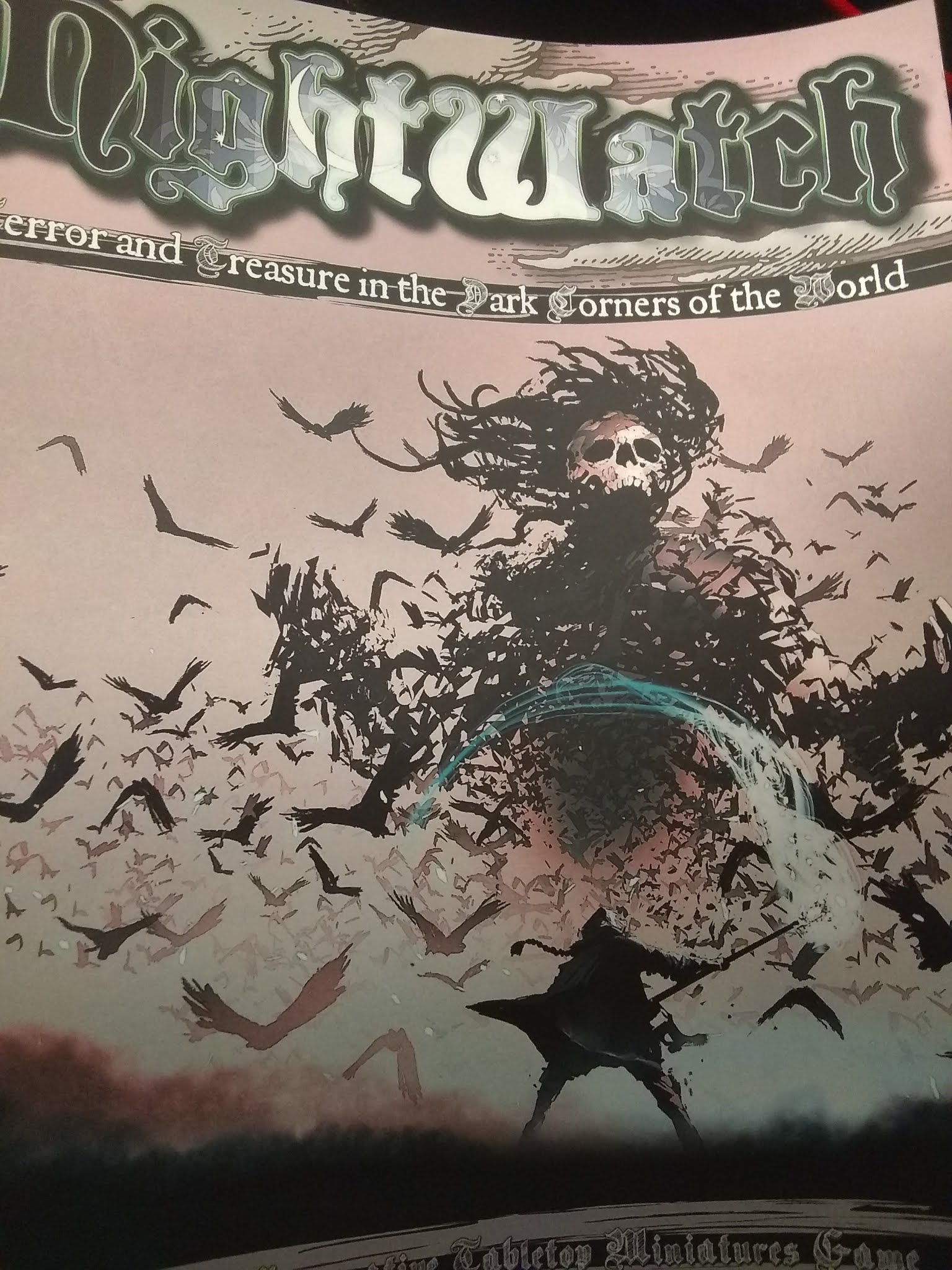
Nightwatch - Spawn Matrix

 Nightwatch: Terror and Treasure in the Dark Corners of the World has proven to be a delightful little solo wargame that has kept your host occupied for hours.  Almost four of them so far, and I'm finally starting to get the hang of all the basic rules.  One thing that I have found helps me need to remember less stuff is to prepare a 'reinforcement' table before the game begins.  Rather than refer to the table in the book and have to remember turn number and what my current difficulty rating is, I can just grab the next batch of baddies and go to town.

Take a look:


The numbers at the top are the turn numbers, the letters down the left hand side represent "Terrors", "Hordes", and "Vermin" from top to bottom.  Now, once my little Guildsters have completed their four actions on a turn, I can just reach over and grab the next column of reinforcements.  This also gives me a solid 'turn counter', because I can just look at the blank columns and know where I am at in the current game.

Here is some tabletop eye candy showing a scrum as four heroes defend the bones of a fallen saint against the ravages of lizardmen:


And if you want to get your hands on a copy for yourself:

Thursday, March 11, 2021

Nightwatch: The Solo Wargame


This is a game about killing monsters. All kinds, anywhere, any time.

So speaketh Patrick Todoroff, the scribe behind Nightwatch.  

This little gem of a wargame is a solo wargame that features a fairly simple core mechanic upon which you can bolt all kinds of weird and wonderful special rules.

The short version is that you take four heroes onto a table filled with terrain and have to accomplish one of the standard wargame objectives. Break a thing. Cross the table. Find a hidden thing and get off the table. That sort of objective. The trick is that there are four spawn points where increasingly strong monsters are going to be pouring onto the table to stop you.

The core mechanic is that each figure gets four actions: a free move and three potential interactions. You've got to roll above a target number of 4+ to succeed. You get one each of the d6, d8, and d10 with which to try and take actions beyond that free move, and that's the core. Each character class gets two things it's good at, and so it can roll two dice looking for a success. Tanks get to roll two dice in melee and resisting damage. Wizards get to roll two dice when casting a spell or moving.

The enemies that spawn on the table have four classes as well. All get a free move and then they scale up in actions from a single d6 to a pair of d8s to three d10s. So each class grows in power exponentially. From one action to three per turn, and an increasing probability of moving and striking, it gets pretty tough. The last class is the big Big Battle, and that last boss has multiple wounds, multiple abilities, and four actions per turn, making it the end-state goal of a seven-plus mission quest.

If it all sounds a bit generic so far that's probably because it is, but that's all part of the beauty of the system. It's meant to be a starting point for you to use your own figures to really make the game come alive.

Got a giant bat swarm? Fine - they are vermin who who fly over obstacles. A minor threat, but one that can zip freely around the table.

Got skeletons? Give them a +1 to resist damage from bladed weapons.

Got a dragon figure? Make it the Big Boss and give it fire breath, flight, and ferocity. It'll make for a serious threat.

It's a refreshingly open game system, and one that looks robust enough after a couple games to allow for just the sort of tinkering that every wargamer does anyway.

Highly recommended.

Monday, March 8, 2021

In The Shadow of Giants

Banged out a quick weekend project recently, with mixed results.  These towering trees look okay, but the roots are nil, and they are way too fragile for regular use.
Classic construction method consisting of paper towel cardboard tubes covered with tissue, and the tissue is held in place with watered down craft glue. The problem is that even with the glue dried they're very lightweight they need a much heavier base probably a cap of something harder than just tissue paper over the top.

 I'll get some use out of them but it's hard to see how many games. Which is fine I don't have enough storage for these things anyway.

Thursday, March 4, 2021

Nightwatch Roster Sheet


My first Nightwatch.

Since nobody else is going to do it, allow me.  If you're ready to play Nightwatcha solo fantasy skirmish game by Stalker7, then you're going to want to use a more compact and efficient character sheet than those in the book.  They are fine.  They get the job done, but they take a full page to do what could be done in a quarter page.


You can either save that roster above and print four to a page using the "3.5-inch by 5-inch" setting on your printer, or print one to a page four times.


[EDIT: On March 15, 2021, I changed this roster sheet to make it more workable at the table.]

Tuesday, March 2, 2021

Nightwatch: The Solo Campaign

So I ordered a copy of this based on the recommendation of a viewer over on the channel, Justo Perez, and it's been a real struggle to read.

Not because of what's in it, but because life is hammering away at me with reckless abandon.  Not sure why, but every time I grab this book there's an emergency that drags my attention away.  Very strange.

And disappointing, because there's some real potential in this book.  It's a smallish skirmish game that looks designed to be played by a single player.  You would think that could be said most skirmish games, but we live in strange times.

You'll take two to four heroes, each of which has stats a bit less complicated than what you'd find in a Warhammer Quest style game.  They look to be more on par with what you see in Frostgrave, which is nice because you can also plug in a handful of less powerful and hence less-complex allies.

Then you've got to handle the hordes of enemies, whose stats are (mostly) single dice.  The bigger named entities stand out with more actions and more special rules that complicate matters, but it still doesn't look unmanageable for a single player. 

We'll have to play through a game or two to know for sure.

For now, I really like what I see.  It's specific where it needs to be specific, vague where it needs to be vague, and just open-ended enough to allow for some exploration.  And how about that tagline?


In a grimdark world where everyone is falling all over themselves to wonder who are the real bad guys, where Disney keeps trying to explain that witches are cool, actually, and literal satanic pedophiles exercise global power, it's nice to find a game that admits...

It's the monsters.
Monsters are bad guys.
Go kill them.

More to follow after this game meets the tabletop.

Thursday, July 2, 2020

A Paladin in Sloretown

For the record, that was my uber-powered Paladin trashing the tracks of the Jeffro Pacific Express Freight to Funkytown.

Before we get into the view from the player side of the screen, a confession: I used this generator to roll up a fighter type and got the stats for a Paladin on the first try.  That was a mistake.  After the session, I rolled up a few more characters with it and discovered to my horror that it uses a modified Method III to guarantee a fighter's stats.  A modified Method III is not Method III, as handed down from the pen of Mister Gygax.

I should have known better.

My only solace is that, due to logistical difficulties, this game was a one-off for me.

And what a one-off it was.

My paladin, Aggros DeLas Aled, tagged along because his master caught him "with his hand in the proverbial cookie jar."

A minor point to add, because it didn't come up again in the session, Aggros isn't the brightest guy and when he said "proverbial" he really meant "literal".  The degenerates in the party assumed he was attempting to atone for the sin of lust when in fact he was atoning for the sin of indulging in carbs during his physique cutting season.

And here we see the value of old school play.  "I was told to help you by my superiors," is a perfectly valid excuse for the wrong kind of character to have to work with a group for which he is ill-suited.  Even a golden souled Paladin understand the value of hierarchy, and can put a willingness to obey the orders of the head of his order above his own personal desires.  That allows him to play along while maintaining a clean conscience.

And as a demonstration of my trust for the dice, consider the following exchange:

DM: The naked demon woman lands next to the whore.
Aggros: I tackle her.
DM:  The demon or the whore?
Aggros:  Hang on.  *rolls dice*  The demon.

Now what, you might ask, would you have done had the dice told Aggros to tackle the whore instead?

Rolled with it.  Aggros would have shielded her from the rain of death about to be unleashed by bow-armed snipers placed at key positions around the area.  He would have cured diseases on her and offered to escort her to the nearest nunnery to take up the habit and leave Trollopolis in the rearview mirror forever.  With some stabbity stabbity of the demonette along the way, naturally.

That also would have made a fine story.  As it happened, it was not the story that fate or chance or luck had in mind that night.

And that's okay.

Because we rocked that demon-lady hard, trussed her up, and delivered her to Elric the King who probably won't make of her a queen to sit by his side until Stormbringer drinks her soul.

Probably.

Friday, May 1, 2020

Scale Neutral Fantasy Terrain

Nothing helps sell the players on the notion of the dungeon as a place of pure, seething chaos like a good altar of evil, expect maybe TWO altars of evil.
 
Finding fifteens in the local FLGS (that aren't remaindered Flames of War remnants) represents one of those fun challenges that true gamers embrace.  This little altar for instance, allegedly scaled for the big 28mm figures, offers a chance of three different pieces for my preferred fifteens.

Of which I took two.  For permanence, the base and top have been joined permanently, creating a sort of summoning circle.  The round altar pillar has a convenient bit of stone finishing on top, making the pedestal a perfect height and look for a dark altar graven with ghastly visages and pressed with the bones of its victims.  Yeah, the skulls on the dais are a little oversized, but that can be chalked up to either stone carven skulls, or the skulls of giants, depending on the DMs mood and inclination.  The latter - ten giants killed to create the dais - has wide ranging implications perfect for your chief, jarl, or king's local steading, rift, or hall.

The pre-primer on these resin pieces didn't work out so well.  The red basecoat, done to provide a hint of eldritch and bloody mortar joining the stones, took several coats to reslly stick.  Next time I will prime coat Wiz-Kid's 'preprimed' figures for better and more consistent coverage.


Thursday, November 24, 2016

On Elves: Idle Thoughts With No Conclusion

 Happy Thanksgiving!  I'm grateful you're all along for this ride.  It's been fun.

Part of my decision to eschew post-1985 versions of D&D is the sheer blandness of it's creativity.  The most recent title by Wizards of the Coast, Volo's Guide to Something or other, includes a host of new player races designed to help tables do new and different things with their games.  From what I gather from its fans, the new and different things amount to little more than new collections of stat modifiers with a bit of chrome thrown in.  That is to say, the new races amount to little more than rubber-suited humans with maybe one dominant personality trait.  
I'm not the tabletop cop.  The hobby has enough of those already.  If that brings you joy, then take your mods, zip up the lizardman suit, and go to fantasy-town.

But it's not for me.  One thing that I'd like to see make a resurgence is the idea of truly alien demi-humans.  Not just different looking, but different thinking.  That's why my dwarves are literal creatures of earth.  They aren't just short hairy humans who like wine, women, and song, they are driven by very different needs.  Granted, they love gold, but it's near and dear to their hearts because it is made of the same stuff they are.  They don't identify stone-traps easily because they build them, but because the very stones themselves speak to a dwarf in ways humans cannot even understand, let alone learn.

What to do with elves and/or elfs has been bothering me for a while.  The dominant view of them as tall, placid, tree-hugging humans, leaves me cold compared to the dark and mysterious creatures of raw magic that you see in Poul Anderson's The Broken Sword or Three Hearts and Three Lions.  The most recent IP that I've encountered that conveyed that sense of menace was the Hellboy sequel with its hidden elven kingdom standing in as the main antagonist.  All this talk is inspired by my current read, John C. Wrights Swan Knight's Son.  So far it is hitting the sheer menace and alieness of elfs right on the head.  It also uses the older plural spelling for a collection of elves, which I've become agnostic on and freely switch between out of sheer impishness.

If you need a little more background to understand where I'm coming from, check out this review of the sequel.  It gives more and better examples than I could.

We see a bit of the elven magic at play when Modlvay's elves are given immunity to sleep and charm spells, and their generally better saving throws.  But where's the aversion to iron in the modern Tolkeinian/Warcraftian fantasy zeitgeist?  Holmes Basic forced elf players to choose whether the character would play as a fighter or wizard - suggesting that elfs could use iron or magic, but not both.  That choice was lost with the Moldvay rules, most likely for reasons of playability, but it definitely serves as a way of making elfs play very different from tall humans.  

Adding in an aversion to iron would be a nice start, mechanically.  It would help remind players that their little avatar isn't just an old, willowy human.  It also makes any iron-age race that much more fearsome to elfs.  A kobold with an iron sword might do an extra d6 damage to elfs - that would give any player pause.  A powerful magic weapon that is crafted from iron - the sword of a long-lost ancient king, for example - might be an iron sword, and thus unavailable to elfs.

Another important method of distinguishing between elves and humans is drawing a sharp contrast between a human's trust in an afterlife and an elf's complete lack of a soul.  When an elf dies, he doesn't go to a better place, he goes nowhere, but is destroyed absolutely.  That has important implications in the game world.  No resurrection - there's nothing to call back to the corpse.  No speak with dead - there's nothing to speak to.  The upshot is that any spell that would trap a creature's soul in a gem or jar would have no effect on an elf.  Lacking a soul, they may even be immune to the healing power of God's clerics.

That might also apply to clerical healing, too.  You want to make players get jittery about playing a class, and handle that class differently, take away their precious cure light wounds.  They've got potions still, but that's a pretty big sign that these guys are different from everyone else.

This would also provide an in-game reason for an elf to crawl into dank holes in the earth.  They are looking for immortality of the sort unavailable to them in the afterlife.  Every lich you meet might be a desperate elf clinging to this mortal coil.

At this point the brain needs to cogitate further, but after recasting dwarves as more than short, hairy, men, I'm really leaning towards a more alien and unknowable race of elfs.

Wednesday, October 26, 2016

Weirdo Beardos

One of the advantages of playing a miniature heavy version of B/X is that it gives you complete control over character selection.  Taking a general WYSIWG approach to things makes it easier to explain to modern players why their super-unique character with the long blah-de-blah backstory - at 0 XP! - falls under the large category of #NotAtMyTable.

Take female dwarves.  Seriously.  Take them.  While you're at it, take any dwarf that has a separate class modifier.  They don't need those, they have a class already.  It's dwarf.

Using B/X as the starting point means race as class.  Which isn't to say players have no choice in the matter.  They can play a sword dwarf or an axe dwarf or even a hammer dwarf.  See?  Lots of choices.  And I've got miniatures for all of them.  What I don't have is miniatures for thief-dwarves or cleric-dwarves or, god forbid, sorcerer-dwarves.  If you play a dwarf yo get enough boosts that you don't need any more of them from having a separate class.  Take your doubled chances to find traps and shifting walls and be happy with them.

Using B/X as the starting point also means that dwarves have dark brown skin and three hair colors: brown, black, and gray.  You'll see this reflected in my painted miniatures.

Pictured: Every 15mm female dwarf figure I could find.
Feel free to prove me wrong.
Using B/X as the starting point also also means that all dwarves have beards.  That tells me that all dwarven adventurers are males.  That's probably true in large part because dwarves are practical (again, canon written in the sacred text as recorded by the prophet Moldvay).  They wouldn't dare squander the lives of their precious womenfolk on such silly things as looting tombs, crawling through deep holes, and plundering long lost ruins.

As I re-read the works of Appendix N, I'm even leaning towards a much more mythic folklore interpretation of dwarves as literal people of the earth, maggots that infest the earth until invested with the gift of reason by way of contact with holy relics or some such excuse that fits better with a semi-Christian background.

Either way, dwarven players have ten choices for representation, because ten dwarves is how many you get in a pack of Ral Partha Europe's Blighthaven range.  Heck, even if I wanted a female dwarf figure, I can't find any on the market in 15mm.  So don't blame me - blame capitalism.

Wednesday, August 10, 2016

Religion in Castle Meatgrinder


So there you are, five levels deep in the bowels of a physical manifestation of the raw forces of chaos, beset by creatures bizarre and malicious, low on spells with not even a half a pack of cigarettes nor a full tank of gas.  There are no atheists in foxholes of the mythic underworld phenotype, so you need yourself a god on whom you can call.

Ah, that conundrum as old as the game itself.  The default pseudo-medieval/dark age setting calls out for a Christianity analog, but a fantasy world with an explicit visitation by our Lord and Savior potentially raises the fun-killing specter of idle speculation about what Christ Dying on a Fantasy Cross means for the fantasy world and for our world.  The strictly agnostic basic rules allow for everything from paganism to pantheism to polytheism, and of course, monotheism.  It's a great cop out that leaves the concepts of Paladins and holy warriors in general bereft of the deeper magic that gives them such punch and import in the literature.  At the same time, the baseline rules leave in such explicitly Christian concepts as devils and angels and posits a wonky kitchen-sink cosmology that solves the problem with a decidedly non-Occam's razoresque solution that resembles the epicycle explanations of orbital mechanics.  Put more simply, by getting the center wrong, the mechanics of the system become needlessly complex.

Good old Pete, architect of Felltower, uses an appropriately hand wavey explanation of "The Good God", who is God as we know it in all but name and actual practice.  It's a great way of forcing the tone to stay light while steering a course close enough to the historical inspiration for medieval fantasy settings without hitting the Two-Jesuses Icberg.  It solves the problem, but leaves things (at least in Peter's re-tellings) a bit bland.

Castle Meatgrinder uses Felltower's implicit Christian faith, but takes the next step and makes the Christian setting explicitly implicit.

Wait, what?

It's explicitly implicit.

The general faith is called The Faith.  That's perhaps an odd misnomer when you consider that it doesn't take much faith to believe in a god whose followers routinely cure diseases and call forth fire from the heavens.  Oh man, see how easy it is to fall into the overanalysis.  It's The Faith, it just is.  Go with it, already.

As in the real world, there are many names and titles for the guy who gave his life to absolve others  of sun, such as The Great Martyr, the Savior, our Holy Lord, and The Shephard.  The Good Book is also known by its many editions: the Holy Book, the Collected Scriptures, the Word of God, all are appropriately vague enough for a fantasy setting.  And while Christ is never mentioned explicitly, His titles all heavily imply that, yeah, it's that guy.  A few more examples:

  • Saint Suggestimus of the Divine Allusion
  • The Chapel of the Holy Innuendo
  • Blessed Mother of the Implication
  • Sepulcher of the Eternal Elbow Nudge

This open call to puns serves a subtle but important dual role at the table.  It keeps the focus of the game on a medieval/dark age European setting, which saves a lot of time as it guarantees that everyone at the table can approach the game with the same basic default understanding of how religion in the game works.  More importantly, it keeps the setting light - it's an open call-to-pun after all - and encourages the players to jump right in and add to the lore of the Church of You-Know-Who.

You don't have to go that far down the road of explicit implications, if players want to keep things a little more serious, they can just leave it at The Savior and the Good Book.  But this opens the door to keeping something very serious and central to medieval life in the game, something that resonates deeply in our souls and adds some wieght to the game, but it does so in a way that keeps things at the table fairly light-hearted.

It also let's us leave the serious religious discussion where it belongs, and where it can be dealt with using the sort of deep introspection and gravity it deserves.  You know, like Twitter.

Yikes

Wednesday, March 16, 2016

Massive Firepots

Another cheap version of an idea originally promulgated by The Crafty DM today.  Two enormous stone firepots resting on massive wooden frames. 


These are, of course, cheap electric tea lights bashed and painted for appropriate dungeon ambiance.  The LED lights in these things aren't very bright, but they flicker a bit.  A subtle effect, but it gets the idea across.

You may have noticed that the old robot used for scale has been replaced by a more fantasy suitable miniature.  The minotaur shown here is actually a Pendraken 10mm figure, but he's a big 10mm, and works well as more of a human sized beastman when used as a 15mm figure.  He's about 15mm to the eyes, to give a better idea of scale.  There are quite a few 'big' 10mm figures that would work well as 'normal' sized 15mm figures.  I'll have to show you a few of the ones I anticipate using.

Sunday, February 21, 2016

Excellent Dungeon Maps

There are a few tidy little dungeon mapping software tools out there online, but none of them were quite what I needed for my simple little Castle Meatgrinder Maps.  With a limited tile set available, I needed something digital that would allow me to drop them in place and rotate them as needed.  It also needed to be a program that let me customize simple icons for my dungeon dressing locations, and maybe drop in some notes to self as well.

 Here's a neat little post discovered while goofing off at work - on my lunch hour, the length of which we won't discuss.  Pretend Heroes shows the world how to use Excel to create simple, but information dense dungeon maps using everybody's favorite spreadsheet software, Excel.

First thing I did was build a suite of my rooms in one worksheet...

...and then drop them into a second worksheet with corridors, furniture, and notes.

That's all I need, and I can throw them together at work any time things get light.  Even better, by copying and pasting one level into a new worksheet, I can ensure that linkages between levels (stairs, pits, etc.) are accurate.

Anybody have any experience doing things this way?

Sunday, January 3, 2016

Tyranny of Dragons, Session 14 - Carnath Roadhouse

After a brief rest amid the splendors of Waterdeep, our plucky band of heroes found themselves heading north once more, once again disguised as humble guards protecting Dragon Cultists who were disguised as a humble road construction crew.  The Lords of Waterdeep had set out to repair the long abandoned north road, which used to allow passage through a massive swampy mire.

On the road to the roadhouse, the party came upon a large stretch of roadway filled with quicksand. This sort of thing had happened a few times along the road, which did pass through a swamp after all.  Skirting the edge of the quicksand, the party quickly learned that this quicksand was dug by bullywugs who had cleverly lain in ambush.

The surprise was total, with the necromancer Gilgamesh taking a beating, outnumbered by the slimy creatures.  At one point he was down to his last death save.
Wizard down - scramble the medics!

But no one could get to him, everyone locked in savage melee with the remaining bullywugs.

Fortunately, his death saves went well, and he managed to stabilize before bleeding out.  Once the rest of the bullywugs and giant frogs were dispatched, the medics patched him up toot sweet.

They had freed lizardman slaves, fought an army of undead, fought through bullywug ambushes, and now finally found themselves at a safe rest-stop: The Carnath Roadhouse.

Let's just pause for a moment to get the Patrick Swayze jokes out of the way once and for all, okay?

Everybody done?  Good.

The Roadhouse was a rough structure built on the only dry patch of land for miles, and served as the construction hub for the project.  Poking around a bit, the party found a secret basement, with a long tunnel that lead off into the swamps where it emerged...right in the center of a kobold work camp! Clearly the work of the Cult of the Dragon.  The noise and approaching light of the party had warned the kobolds, who set about defending their camp with a fervor based more in faith than in skill.  The fight was short and bloody, but two kobolds escaped to warn...well, the party wasn't about to wait to find out.

Hurt, wet, muddy, with their cover blown and with their resources depleted, the party elected to move off a ways into the swamp and camp to rest and recuperate.

And that's where we left the session.  That's also where this narrative trails off.  Your humble blogger has two too many irons in his fire right now, and the D&D sessions are going to have to take the hit.  As you can tell from the increasing infrequency of this portion of the blog, it's been getting harder and harder to make the sessions.  Rather than string the group, and you, along, it's time to put this story to rest.