Reading through some old Featherstone books, I've been bit by the Napoleonics bug. Maybe it's age and the fear of not getting to the things I always meant to get to, but whatever the reason, I'm eyeing horse, foot, and guns. More than eyeing, I've been slapping paint!
The gun on the right is new, and matches up well with my other cannon. I bought a crew in older uniforms painted in gray to allow them to be used for either side. Meanwhile, four French cannoniers stand by to serve. All eight are from Irregular Miniatures, but I think the guns are from Eureka.
Okay, these Frenchie bois are really suited up more for fighting in the French Revolutionary wars, but whatever. My Brits are suited up for the American War of Independence. Squint.
This unit of line infantry are also from Irregular and they paint up really well. I'll throw together a comparison shot of Irregular with Eureka figs next time.
Meanwhile, I've even got some horse boys, seven in all, to go with them. With all of this done, I now have enough forces to start playing around with Osprey's "Chosen Men".
Eureka just send me more metal figs so that I can expand my current 300 points of Red vs. Blue and add in some variety. Then maybe we can think about running a Featherstone map based campaign just like they used to do.
Mostly eye candy today with some thoughts on "A Song of Drums and Shakos". It's just a reskin of Andrea Sfiligoi's "Song of..." series, but I'm really glad to have added it to my library. Having the background and points lists for each army really makes it a snap for a Nappy neophyte like myself to throw a game down and get to rolling.
Here we see a veteran unit of French trying to hold a crossroads following defeat at Tres Verdes. The Redcoats are in full pursuit, and if this French unit can do enough damage to a squad of British dragoons before they cross the table, they can save a lot of lives. Unfortunately for the, the British have an equal number of green infantry on the way as well. The British infantry hope to do enough damage or at least distract the French enough to allow the dragoons to slip past.
The French commander opts to split his forces. He positions three men in the woods between the two fords with the bulk of his men inside the small hedged farm field. Here you can see the larger unit of British as they advance in two waves.
Having disrupted the French a bit, it's time for the British Dragoons to begin their race northward...
Refusing to be distracted, the French quickly put down the first two mounted enemy...
To win, the British need to get four horses off the road on the north side of the table. Here you can see that two of them are off, with a third just about to cross the finish line.
All that remains is for the British squadron leader to make his escape...
To find out how this fight ends, check out the full battle play over on "The Joy of Wargaming"!
Oooo, what a bait and switch. Have I no shame? Apparently not.
Sometimes the best way to fight...is not to fight at all.
Today we're talking about some painful lessons learned from a game of 2 x 2 Napoleonics. It has taken me an embarrassingly long time to get a handle on how to work this ruleset.
In the Battle of Lake Sambee, an overwhelming force of Albans are invading the Tenebran Nation, looking to return the city of Grandepoint to the Alban fold. Or to return the Grandepoint silver mines to Alban control. Tomato, tomahto.
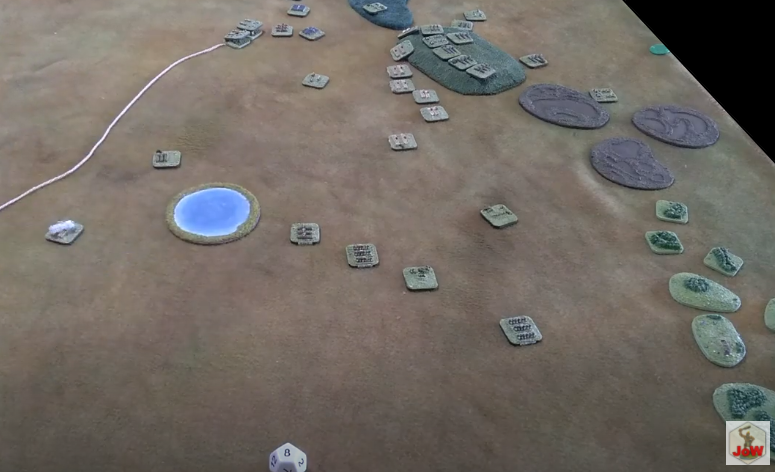
Here's the general run of things. As you can see, the Albans brought a large force up between the lake in the center a small farm on the north. The Tenebrans, led by a very skilled general, took command of a large hill whose flanks were secured by heavy woods to the north, and swamps and light woods to the south. A very defensible position.
Undaunted, the Albans used cannons to secure the farm on their left flank, and tasked a smaller blocking force in the south to secure their right.
Thanks in large part to my n00bishness, the Alban attack failed spectacularly.
The Alban right fell apart so quickly it put pressure on the center to make a move on the hill before they were really prepared. That main attack had to break off units to reinforce the right, costing them even more momentum.
In retrospect, the Albans should have brought all their artillery - six to the Tenebran two - forward to long range and pounded away at that hill for as many turns as it took to scramble the lines, and then sent in the horses. They had time, but pushed forward too fast. Or, since the win conditions relate to the number of stands destroyed, they should have hung back and used everything they could to destroy that Tenebran southern flanking force before turning their attention to the hill.
Or perhaps the Alban artillery should have gone full Grande Battery, set up at 8-inch range, and just pounded that hill into rubble. Turns out a Napoleonic approach to Napoleonic wargames is a winner! Who knew?
Part of it is on the nature of things.
This comes up in later episodes, but is worth a blog post. After determining the terrain, setting up the physical space and the units, and getting everything ready to go...sometimes its obvious the smart play for one general is to refuse battle. The Albans should have backed off and waited a few days to come at the Tenebrans from a position of - if not advantage, at least less of a disadvantage. Particularly so, given that this is part of a much larger campaign where no general can afford to make a 'throw away' attack.
Calling it quits without firing a shot would mean all the set up was for naught! Like so many generals before me, I had to learn the hard way that a poorly conceived attack is a far larger waste. And that is a hard lesson learned on my part.
But we're getting there. Always learning, and always improving, that's part of the Joy of Wargaming.
If you want to watch the whole battle, you can find it here:
More black powder gaming using a neat little trick for roads and streams...
Simple yarn. It's just the right scale for 2mm figures, and you can nudge it all about to make just the right curves. Placed down on a fleece battlemat and it works a treat.