Thursday, September 30, 2021
The Great Migration
Saturday, July 24, 2021
Who Cares What Non-Wargamers Think About Wargaming?
Read between the lines here and you'll find something a little more pernicious than the usual, "this needs more study, so make sure you hit that FUND button!" conclusion. There is a strong push underway for the entire hobby to shift its focus from wargamers to non-wargamers, and down that path leads only madness.
| Madness. |
As usual, the people pushing this new narrative fall into two camps: those who see our robust, healthy, long-lived, fun, and exciting hobby as ripe for conquest, and those who are already in the hobby who stink of a desperate need for approval from outsiders. So desperate are they for approval from people who want to radically and fundamentally change the hobby that they would burn the village to the ground to prove their worth to these outsiders.
As usual, this strategy - welcoming people who don't wargame to help define what it means to wargame - is being sold as a way to save the hobby. From what? Dunno. We live in a golden age where we are spoiled for choice. Rules, figures, paints, communities, you name it, we've got more than we can handle already. It is a fun and exciting time to be a part of this hobby, and it's no wonder more and more people want to be a part of it. The problem enters in when people who don't participate want to define what it means to participate.
Painting is a part of this hobby, sure. Collecting is a part of this hobby, sure. History is a part of this hobby, sure. Math is a part of this hobby, sure. Writing is a part of this hobby, sure. But all of those aspects are buttresses that support the main cathedral of...wait for it...PLAYING THE DAMN GAMES.
You laugh, but people are already asking non-players what the hobby community should do to change the hobby to suit their non-playing desires. The answer of course is that the hobby should keep on doing what it has always done, and those who don't like it can change themselves or go pound sand.
| Because you are a psychopath. |
The hobby is fine. We don't need any johnny-come-latelies and hangers-on to tell us what we should do to cater to their whims. These locusts will just move on once they've eaten all the seed corn anyway.
Just a warning that too few will heed. I expect that wargaming will go the way of fantasy books, vidya, comics, TTRPGs, and a host of other hobbies. The forces arrayed against her are too wealthy, too motivated, and too experienced to be turned back for long.
And you know what? It's okay. We built this hobby from nothing once, and we can do it again. Hell, within the tabletop RPG community the BROSR is actively rebuilding D&D for the second time even as we speak. (The first was the OSR, which failed to regress hard enough. This time around we're reclaiming the Gygaxian method of complex games that never turn off.) All we need to do is protect our tables and our conversations and our local (internet or meat-space) implementation. We can build our own little redoubts, free from the brain-virus that has infected so much of our culture. And when Big Mini crumbles, which will take some time but is inevitable, we'll still be here, plugging away in delightful obscurity and thumbing our noses at our would-be conquerors.
Gatekeep your hobbies. Gatekeep your tables.
Monday, July 5, 2021
A Tale As Old as Time
Brace yourself for a revolution in table-top RPGs.
At last, after forty years of D&D and twenty years of instant and always-on communications, the two have been married to create a style that is a literal game changer:
But it ain't me. It's Jeffro, the madman that redefined how to approach background research for D&D sessions with his ground-breaking literary analysis - an analysis so profound it was memory holed for five years before the woke crowd trotted out a low-energy goof to spoof Appendix N with a cheap and flaccid imitation.
Here's the man with the plan himself:
Maybe we didn’t need to adapt seventies style rpg lore to eighties style module conventions. Maybe we needed to adapt ourselves to even more seventies era rpg lore! 1:1 timekeeping with multiple independent domain-level actors is fundamental axiom we have been missing. Here is what you get by implementing this one neat trick.
His latest post also features links to two other campaigns that are doing similar ground-breaking work. Proof of concept, if you will.
- Every monster lair you hand over to a real player will necessarily generate a personalized and idiosyncratic encounter locations...
- When player characters need to interact with a domain level player, the DM does not need to improvise something to fit the type of adventure he is trying to run...
- There will be so much domain-level information being generated and no way to create fair or useful session reports that you will have no choice but to set up a news feed for your campaign...
- Similarly, your campaign will immediately begin spontaneously generating SECRETS...
Click here to learn more about this one weird trick and what it can do for your table.
Once people try this, and decide they like it, you can expect a lot of fascinating discussion on the what, the how and the why. Jeffro has barely begun to scratch the surface of this fundamental mindset shift. There is a lot of room for more input, experimentation, and discovery here, people. It reminds me of the earliest days of the OSR, when people were falling all over themselves to discover and reinvent the minutiae of Moldvay-style D&D, but this time it's even bigger than a retreat and reskin of the easy mode of the 1980s. It's a complete renovation from the ground up.
And finally, as always, when a critical mass of people adopt this style for their own table, you can expect a deluge of smart-boy posts from the Usual Crowds staking a claim to have "always known" about the glories of real-time and always-on gaming:
Or maybe not. This system of spontaneously generated adventure doesn't lend itself to the subscription model that keeps the grifters in business. It's inherently a table-directed style that doesn't rely on the imagination of others. It's a focus on the hobby side of the game rather than the consumer side of the game, and without a clear path to profit the guys with dollar signs in their eyes might just continue to play the role of Baghdad Bob, insisting that there's nothing to see here, that everything is fine in D&D-land, and whatever you do, just ignore those guys laughing riotously and enjoying long-lived, robust, and authentic D&D campaigns over there near the wieght machines.
Friday, April 23, 2021
Song of Drums and Shakos - First Runthrough
It works!
| Needs more flags |
Note also, this is my first foray into proper Napoleonics. Though I have dabbled with the French Counter-Revolution to get my feet wet, this remains my first real game of proper Napoleonics with Brits versus French on the road from Tres Verdes. It was a grand adventure that really came down to the last turn, and I'm looking forward to re-fighting the scenario with a few tweaks to make it even more interesting.
Tuesday, April 6, 2021
From Two-Deep to Three
Saturday, March 13, 2021
Wargame Theory
Not judging. Just observing.
Sunday, October 18, 2020
Twargame Advice
A world of advice on using Twitter to get your wargaming fix:
Stay away from the #warmonger tag. It's for people who don't do a lot of wargaming. They like "thuh comm-MUNE-itay". You get lots of ads for milktoast content providers and soy-based podcasts. A lot of paint-by-numbers figures that will never face the trial of the dice. Lots of consoomer activity with maybe a splash of vaguely wargamey webcomic art (circa-1998 in style).
Not a whole lot of wargaming, tho.
![]() |
| Warmongers. Nothing a little testosterone supplement can't fix. |
You're looking for the #wargame tag - that's where people who actually wargame show up to show off their tables and link to interesting blog posts.
An odd dichotomy, but one for which I am grateful.
By way of apolgy for all those wahah!-wahah!-wa-hacky! soy-faces, let me recommend a solid channel for those of us looking to up our painting game. Vince Venruella isn't a personality whose primary goal is establishing a brand. His videos are not bookended by marketing ploys and video diaries and tedious attempts at humor. Instead, they are hugely informative, densely packed with the theories and fundamentals of painting, and all presented in a cool and casual style that educates.
Tuesday, September 29, 2020
Wednesday, September 9, 2020
More Vendeean Eye Candy
Monday, August 10, 2020
Wargaming Social Media
Wednesday, August 5, 2020
The Wargaming Don
Since staring the Joy of Wargaming channel, I've been doing a lot more gaming than ever. It has all been solo wargaming, but not because of the 800-pound virus-gorilla in the room. It's because I prefer my own company to that of the typical specimen of wargamer that hangs out at the local FLGS. No slight against them, they just aren't my kind of people.
It's been nice to roll more dice, but something has been off with the experience. It took going back to the very beginning to figure out what was jangling my danglings.
Instead of looking back to the 80s, I turned my attention back to the 60s. I'm talking way back to the 60s.To 1973 to be precise.
Donald Featherstone is the father of modern wargaming, by way of his authorship of numerous seminal texts that outlined and defined much of how we wargame today. Full of theory and suggestions and guidance, much of what he wrote has filtered down to us through various iterations of wargame rules, and much has been lost along the way. Working in an analog world, he found means to do things on the table that computers now do for us. He also does it in a way that is very inspirational. Here he reminds us of a truth so obvious we tend to forget it sometimes:
Solo wargaming can be so much more than merely lining up to forces and slamming them together. He has a lot of thoughts on how to craft wargaming challenges at which the solo wargamer can tilt for a more satisfying achievement. Proto-AI, fog of war, random terrain and deployment, and a host of other arrows lie in wait for the serious wargamer to add to his own quiver.
It's an engaging read, and it has changed my approach to wargaming in some fundamental ways. In upcoming videos and blog posts, I'll walk you through some of his more obscure recommendations.
Meanwhile, you can expand your wargaming horizons by reading it for yourself. Go back to the start and see if you can chart a better wargaming path for yourself than what the corporate gaming interests have handed to you in a slick box.
Get a digital copy of Solo Wargaming here for just ten bucks. It'll be the best ten bucks you spent on wargaming this year:
Friday, November 11, 2016
Moving Day, Helping a Friend
There's a new blog on the block that should be of interest to anyone who has been following my own conversion over to the (latest) One True Scale: 15mm Skirmish. You probably already know Sam Pate from his blog, Wee Blokes. He has decided to open a blog specifically for his forays into 15mm skirmish gaming.One of my plans for 2017 is to push on with my delayed exploration into 15mm Skirmish Gaming. I know it happens but the majority of 15mm posts I find are either figure reviews or larger battle reports\games. Similarly most Skirmish posts I find are in 28mm. Having dabbled my toes in I feel that 15mm Skirmish has something different in its play, more than "the same but smaller". The scale distances and movement seem more open, so (in theory) the tactics could be as well.
Sunday, February 21, 2016
Excellent Dungeon Maps
Here's a neat little post discovered while goofing off at work - on my lunch hour, the length of which we won't discuss. Pretend Heroes shows the world how to use Excel to create simple, but information dense dungeon maps using everybody's favorite spreadsheet software, Excel.
First thing I did was build a suite of my rooms in one worksheet...
...and then drop them into a second worksheet with corridors, furniture, and notes.
That's all I need, and I can throw them together at work any time things get light. Even better, by copying and pasting one level into a new worksheet, I can ensure that linkages between levels (stairs, pits, etc.) are accurate.
Anybody have any experience doing things this way?
Friday, February 5, 2016
Never Paint Alone - A Podcast Recommendation
![]() |
| In The Garage |
One of my more recent additions is a podcast made just for guys like me, and if you're reading this, probably for guys like you. In The Garage is pretty much two guys who sit around for an hour talking about 15mm scale miniature wargaming.
Friday, January 22, 2016
Amazon is the Grown Up Version of the Tooth Fairy
Thursday, January 7, 2016
Small Box Blues, Part Four
These mock-ups of tiles are based on a repeating regular polygon pattern called a Cairo Tessellation. The pentagon has four equal sides and a fifth, longer side. Two of the angles are right angles, so you could combine this pattern with square tiles to get some very interesting results.
The green lines are an experiment in wall placement. If you put doorways at the center of each side, then you can be assured that everything lines up. Leave one or two sidewalls completely open and you can easily build large chambers, too.
I abandoned this idea when it became obvious that you're going to have to sacrifice too much gameable space in the box. Remember that my box limits me to roughly three stories worth of tiles, and I'd only get three large or six small tiles total. That's just not enough to satisfy me. I could stack them on their sides and fit seven or eight, but each one would be even smaller than the ones shown here. That still leaves a lot to be desired.
Tune in tomorrow for the thrilling conclusion and solution to the Small Box Blues!
Tuesday, January 5, 2016
Small Box Blues, Part Two
The maze gives you a lot of flexibility at the cost of visual appeal. The walls are left generic so that they can represent anything; any specific feature that draws attention to the purpose of the room limits your flexibility. Furniture scatter terrain serves that purpose. A stove marks the galley, a bed marks the bunk, and a command chair marks the bridge. A standard assumption of the maze is that the perimeter of the drop cloth actually represents invisible walls.
In practice, there is little to distinguish the maze from an outdoor setup. You've got a rectangular battlefield with large terrain pieces scattered about that influence your decision making process. The terrain may be linear walls instead of blobby buildings and woods, but you're still playing on a plane surface broken by impassable terrain.
Tiling gives you the ability to designate spaces by purpose. Now, in addition to the stove, you've got a menu and cabinets line the walls, and the command chair faces large viewing portholes. You get a much more appealing look at the cost of flexibility. You also gain fully visible exterior walls, further marking the gamable space as firmly "inside".
A tiled battlefield feels very different from the maze. It's more claustrophobic as everywhere you turn, there's another wall. You wind up thinking more in line with real world interiors ("Better send three guys through the garage bay to flank them through that dining hall.") than you do with a maze. The game play might be similar, but having real world features helps turn things from a gladiator arena to a living space. It changes both the aesthetic and the game play.
So if you're looking for an actual interior, it's well worth it to create actual tiles. Which would bring us back to my new box set, but before we do that, let's look at a couple of cool hybrid strategies implemented by other bloggers.
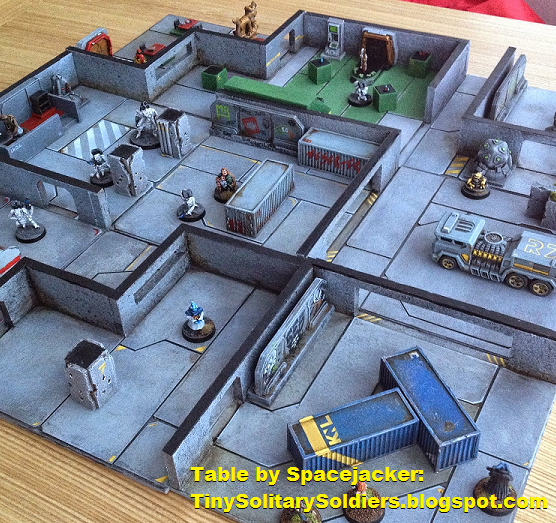
Spacejacker built a blank tile set with themed scatter terrain. It's an elegant solution which allows for a lot of flexibility, while capturing the interior feel.
Stalker7 built a maze on top of tiles.
There are a lot more clever ideas out there, but that gives you some idea for how smart people approach this situation. Next time we'll look at how a dumb person does it.
Monday, January 4, 2016
Small Box Blues, Part One
Any place that a figure can move to or shoot through is part of the gamable space. The most common limits to gamable space are marked by the edge of a ground cloth, which can be fabric, foam, or even the edge of the table. Sometimes we limit gamable space within those out boundaries by placing 'no-go' areas like the space between halls and rooms in a dungeon or space hulk, or impassable terrain like mountains or un-scalable buildings. If the game can't go there, it isn't gamable space.
That is a central concept so tied into the game that we never really think about it beyond answering the questions of how much space do you need, and what happens when a figure leaves that space. It takes on significantly more import when you are trying to get as much of that space into as little storage space as possible. And that's the subject of today's post.
The arbitrary and artificial limitation that I have placed on my gaming, that a full set of terrain must fit inside a smallish box, makes things challenging. Gaming primarily in 15-mm skirmish settings eases that pain a bit; you only need to build up enough terrain to cover two- to three- foot squares of real estate. That still leaves you with a situation where space inside the storage box is at a premium.
One solution to this are as old as gaming itself. Namely, throw in a drop cloth of the right size and five to ten pieces of scatter terrain such as buildings, roads, forests, and hills. It works great - you get a big space with a lot of variation with very little space investment. I took this classic approach with the first big box set.
![]() |
| I don't think I've ever showed how my sci-fi battlefield all packs up into one small box. |
Even with the dedicated roadways limiting terrain placement, there are still countless ways to vary the setup. You can even block those long firing lanes with appropriate scatter terrain such as vehicles, concrete traffic barriers, and makeshift barricades. The possibilities are limitless. With a ground cloth that is roughly two- by three- feet across, you always get six square feet of battlefield.
![]() |
| That box is roughly 6 by 8 by 10 inches |
The theme of this next terrain set would not consist of another outdoor drop cloth setup - we already have one of those. This time around would be an interior setup, or at least something similar. The challenge with interior setups is that pesky third dimension. Now you have to consider how tall to build your walls, and that limits the horizontal space. You can fold up a drop cloth and cover up to twelve box footprints (eight square feet of battlefield) in just an inch or two of vertical space, with plenty of space left over for set-piece and scatter terrain. If your interior tiles have walls an inch high, you can only fit six tiles (four square feet of battlefield) with no room left over.
My initial thought was to build a series of nesting rooftops. Back in early November I shared a couple of photos of the first phase of my new box set of terrain. By nesting the rooftops inside each other, you're looking at four pieces of terrain, each about nine by eleven, that fit together to give you about 2.75 square feet of gamable space. You can extend that a little by not butting each right up against each other. The alleys between are still gamable - you can shoot or even leap over them - but now you've got four islands and a lot fewer lanes for movement. Goodbye flexibility, hello overwatch!
We can do better. But how?
Tomorrow we'll look at some possible solutions, including a few clever ideas from my fellow wargame bloggers.
Monday, December 28, 2015
The Wargaming Triangle
For wargaming that constant balance seems to be time, money, and space. In high school, I had all the time in the world, but no money and no space. When I started this blog, I had all the time and money needed, but no space - hence the "In A Box" theme making a virtue out of necessity. Now that I have a crazy long commute there aren't enough hours in the day.
But that's okay. There's no pressure, so I can build up a nice lead reserve for when the times get lean and the commute gets shorter. When the kids go to college I'll have more time and space, and if I've invested in unpainted figures right won't need to spend quite so much money.
Which makes this all a 'round about way of justifying a large lead pile. It's not frivolous impulse purchases or an addiction - it's an investment. In the future!
Saturday, December 19, 2015
Towards a Unified Theory of Wargaming Complexity
Earlier this week, Delta Vector (you know Delta, he runs the excellent Delta Vector blog) posted the latest installment of his in-depth analysis of wargame design, this one on the perfect number of units. The entire series is well worth your time, as he devotes each post to a detailed look at different ways of managing wargames with copious examples from around the genre. In this installment he comes to the conclusion that the right number of units is between 5 and 12.