Showing posts with label rules. Show all posts

Tuesday, September 21, 2021

GADD About Miniature Wargames

Hi, everyone.  My name is Jon, and I suffer from Gamer ADD.

Well, not so much 'suffer from', as 'revel in'.
How can you not, when we have the pleasure of being born in the right time and at the right place to enjoy this late-stage golden-age of the hobby?  And yet I find myself looking back to Tradition, and taking up the challenge of Napoleonics.  These French light infantry need some grass on the field and maybe a flag but are otherwise ready to play ball.  A small unit of seven gives them a lot of flexibility and just enough punch to keep the Redcoats hopping.
As reported before, I'm getting deep into Osprey's "Chosen Men" and finding it a fun little throwback. It's been called a Warhammer knock-off, and I can't speak to that except to say that the game is just a lot of fun.  It allows for a lot of customization for that sweet off-table fun of army building, uses a tidy alternating activation system, and doesn't suffer when you ignore fairly sizable chunks of the command rules.  Seriously, some of the order stuff takes a long time to wrap your head around, and the game remains just as fun even without those rules.

One minor nit-pick - the lists assume you're building troops in increments of either five or ten, and swapping out fighters for standard bearers, buglers, and trumpeteers.  Eh.  I pro-rate the costs and use units of whatever size I have on hand.  If that means a unit of seven figures on one side and nine on the other, so be it.  As long as the points generally work out, it's all good.

Let's close with a bit more art.  These foot dragoons will never see the back of a horse - Chosen Men operates at too small and furious a scale to allow for the business of dismounting, horse wrangling, and whatnot.  But they will show up as hardy skirmish types ready to seize ground and hold until relieved.  Like the paratroopers of the day, they dive deep into the enemy territory and embed themselves like an Alabama tick, and the look so much better while doing so.  Normally fielded in units of five, as with the rest of the units in this game, I allow for larger troops to get the most out of my collection.


Friday, September 10, 2021

Clever Scenario Design

Wargaming videos make a fine soundtrack for painting sessions, and every once in a while you stumble across a bit of genius you can't wait to steal.  This wonderful battle report from House of Hengist Comics Wargaming Channel struck me as a novel sort of game, and one of those rare scenarios that I've never played.  It's a WWII fight, a little slice of Market Garden fought using Flames of War, but at it's core is a very different sort of scenario than the usual 'line 'em up and crash into each other'.  As ever, we can take the ball from Hengist and run with in a direction more suited to our own style and purpose.

The basic idea is a race for an objective as shown here.  Two forces running parallel to each other, both seeking to claim an objective at the far end of the table.  The center line of the table is broken by terrain that blocks movement and line of sight, with only one or two breaks to allow for that all-important tactical decision tree.  Here, we've got a Napoleonic skirmish that pits two equal sized forces, both entering the table from the west.

On this much simplified level, the major decision point arises from the question of whether to waste time and resources seizing the bridge and perhaps cutting the enemy's forces in half, or fully commit everything to grabbing the fields to the east.  The enclosed fields are rough terrain, and not well-suited for cavalry maneuvers, adding the complication that the units on each side that can get there first are not the best for holding onto that ground.

To complicate matters, and this might have been a wrinkle too many, I held one (random) unit in reserve on both sides of the fight.  That uncertainty adds additional weight to the choice of whether to drive across the bridge, given the increased probability of cutting the enemy's forces or at least delaying any reinforcements long enough to allow your other forces to dig-in for the delayed counter-attack.

No spoilers. To find out how the fight went, you'll have to check out the channel later this month when the play-through video of this "Chosen Men" scenario goes live.  For now, you'll have to settle for some pretty shots of the fancy lads in their fighting gear.

Yeah, I used a post-it note to mark the British Major. Some day I'll have a reliable printer or get around to painting up a suitable flag on my own. Some day.

Okay, slight spoiler for those who know "Chosen Men" - that cannon rolled snake eyes while trying to thin the redcoat herd to the north.  This is too nice of a picture not to memorialize here.


Sunday, September 5, 2021

Gaslands - A Few Thoughts On City Streets

 My Gaslands set up is a little unusual in that all my fights take place on the streets of Midville, USA.

This leads to two big differences between the games shown on The Joy of Wargaming and most other videos - two differences that largely balance each other out.  For one thing, driving on city-streets means that your car has a lot more opportunity to push its luck and re-roll skid dice.  Not always, but often enough that my games feature a lot more driving between Wipe Out checks than most other games.

Notice, however, that the existence of parking lots, sidewalks, and grassy areas means that enough areas remain "rough going" that players have to consider their routes a few moves head lest they lost that advantage of the free Luck Push.  Sometimes it makes sense to eat the roll to get a better line of attack, and that leads to significantly more interesting tactical choices than a dirt lot with a few obstacles.

On the other hand, this is balanced out by the necessarily narrow city streets.  The tight confines and limited drivable space makes all the Luck Pushing not just a luxury but a necessity.  If you want to get the right line at the right time, you're going to need both Spin and Slide results at the right time, and you're going to need to keep a tight lid on the number of hazard tokens on your car to keep those options available.

It's not exactly a different game, but it's a whole different way of playing the game.  And it's one rich with possibilites that I high recommend to any aficionado of the sweet science of vehicular mayhem.
 

Drivers and pedestrians alike!

Friday, August 20, 2021

It Begins

Remember when I said the following?

[W]hen a critical mass of people adopt [the lost art of Gygaxian campaign play] for their own table, you can expect a deluge of smart-boy posts from the Usual Crowds staking a claim to have "always known" about the glories of real-time and always-on gaming.

It begins:

This is another aspect of old school play that I think is forgotten nowadays: the play of multiple characters. In my House of Worms campaign, this is not unusual. Most of the players have several characters whom they can play at any given time, depending on what is happening in the session.

It's nice to see a recognition of the value of Gygaxian play.  Really looking forward to Jimmy Mal discovering the value of 1:1 timekeeping and having always used it but just never got around to mentioning it until lately.  Grognardia is also on the cusp of discovering the joys of faction play all on his own from reading the Big Three D&D books and just about ready to tell you all about his breakthrough realizations that he had all on his own. 

Not even being ironic or sarcastic here*.

The guys who have been pushing the D&D envelop and making Real D&D sing for the last year or so have been pushing back against some pretty stiff resistance.  To see others adopt and claim the OG (Original Gygax) for their own is gratifying.  While I can't speak for the rest of that crowd, I can speak for myself when I say that I'm not pushing this new/old style of play for my own gratification.  I genuinely want to make play better at your table, and if it takes time for these ideas to percolate through the culture deep enough for the smart boys to pick up the signal and run with it - great!

Heck, J-Mal probably doesn't even understand where this new shift in the conversation came from.  It's just...you know...this thing that's out there or whatever.  You can't explain it, it's just one of those "nothing can stop an idea whose time has come" things.  It's just what people who shall remain nameless because everybody is talking about it are talking about.  And hey, if it's an idea that needs somebody to jump in front of the parade dedicated to it, rest assured there are plenty of people trying to sell you products who are more than happy to jump in front of the band.

Meanwhile - you and me? - we know where these discussions come from.  We know who to watch to see what people will be talking about next month, and why.  We know why people are talking about last month's news.  As usual, we're one step ahead of the crowd and already turning our attention to deeper mysteries. 


*Okay, maybe a little.

Saturday, July 24, 2021

Who Cares What Non-Wargamers Think About Wargaming?

Karwansaray Publishing recently dropped a link to a low effort "scientific study" that used data collected by said publisher to reveal some surprising things about wargamers.  Did you know competitive people prefer competition games, and cooperative people prefer collaborative games?  You might have thought this, but thanks to the magic of science and with the gracious permission of our technocratice overlords we now have permission to say so - we now have that all important SOURCE to which  we can link.

So dumb.

Anyway, aside from the "no shit sherlock" portion of the "study", we also have the real impetus for conducting this research:

Read between the lines here and you'll find something a little more pernicious than the usual, "this needs more study, so make sure you hit that FUND button!" conclusion.  There is a strong push underway for the entire hobby to shift its focus from wargamers to non-wargamers, and down that path leads only madness.

Madness.

As usual, the people pushing this new narrative fall into two camps: those who see our robust, healthy, long-lived, fun, and exciting hobby as ripe for conquest, and those who are already in the hobby who stink of a desperate need for approval from outsiders.  So desperate are they for approval from people who want to radically and fundamentally change the hobby that they would burn the village to the ground to prove their worth to these outsiders.

As usual, this strategy - welcoming people who don't wargame to help define what it means to wargame - is being sold as a way to save the hobby.  From what?  Dunno.  We live in a golden age where we are spoiled for choice.  Rules, figures, paints, communities, you name it, we've got more than we can handle already.  It is a fun and exciting time to be a part of this hobby, and it's no wonder more and more people want to be a part of it.  The problem enters in when people who don't participate want to define what it means to participate.

Painting is a part of this hobby, sure.  Collecting is a part of this hobby, sure.  History is a part of this hobby, sure.  Math is a part of this hobby, sure.  Writing is a part of this hobby, sure.  But all of those aspects are buttresses that support the main cathedral of...wait for it...PLAYING THE DAMN GAMES.

You laugh, but people are already asking non-players what the hobby community should do to change the hobby to suit their non-playing desires.  The answer of course is that the hobby should keep on doing what it has always done, and those who don't like it can change themselves or go pound sand.

Because you are a psychopath.

The hobby is fine.  We don't need any johnny-come-latelies and hangers-on to tell us what we should do to cater to their whims.  These locusts will just move on once they've eaten all the seed corn anyway.

Just a warning that too few will heed.  I expect that wargaming will go the way of fantasy books, vidya, comics, TTRPGs, and a host of other hobbies.  The forces arrayed against her are too wealthy, too motivated, and too experienced to be turned back for long.


And you know what?  It's okay.  We built this hobby from nothing once, and we can do it again.  Hell, within the tabletop RPG community the BROSR is actively rebuilding D&D for the second time even as we speak.  (The first was the OSR, which failed to regress hard enough.  This time around we're reclaiming the Gygaxian method of complex games that never turn off.)  All we need to do is protect our tables and our conversations and our local (internet or meat-space) implementation.  We can build our own little redoubts, free from the brain-virus that has infected so much of our culture.  And when Big Mini crumbles, which will take some time but is inevitable, we'll still be here, plugging away in delightful obscurity and thumbing our noses at our would-be conquerors.


Gatekeep your hobbies.  Gatekeep your tables.  

Wednesday, July 14, 2021

Cha'alt 28

The Blackraven action has shifted to the alien planet of space weirdos some call Cha'alt. 
And that means it is time for some eye-candy.  Here we see the Cult of the Spicy Wyrm, ambushed by the ragtag band on the right.  For some reason, Cobalt-15 brought the MSB along on the mission to ambush these pilgrims and steal a sacred relic that took the form of a pretty juicy rifle.

Now, in all it's glory, and with the fuchsia skies of the drug-addled planet of mystery, we can play some Planet 28 and figure out how well it works for a long-run narrative campaign. 
The short story is...not great.  It's a fun little skirmish game, but it's really made more for short-run campaigns filled with nameless mooks.  It's a brutal game that is hard on its characters, and the advance system doesn't allow for a whole lot advancement without incurring a whole lot of devolution along the way.  The cost to stay in business just overwhelms any advances you earn along the way.

Or perhaps the game shines when you're running campaigns of 5+ games.  That's possible, but at three games and ready to move on, I can't say for sure.  If you have a few teams going against each other then the drop in team quality over time should be matched by that of your opponents.  Or maybe in a 'race against time' campaign, one where you're struggling to preserve your resources for as long as possible, it could work great.  The core rules are certainly robust and offer a lot of room to play with different team strategies.

But for an episodic throwback to 1980s action-adventure TV where you're looking to bop on through various settings and fun, it just doesn't work out all that well.

Highly recommended for what it is, but what it is just isn't what I'm into at the moment.


Sunday, April 18, 2021

Shots Fired!

Related to yesterday's post regarding people who have been playing AD&D wrong for decades - a club of which I was a solid member of for decades myself - Jeffro offers up a little look at what we've all been doing wrong for lo these many years:
Why this rule is there exactly is not immediately obvious. If you experimented with it at all, you would understand that this simple and strange sounding idea is one of the best ideas in gaming history BAR NONE. If you were also familiar with just what precisely Dave Arneson did with Blackmoor, you would realize that this rule was the key that allowed him to manage as massive and complex of a campaign as he in fact did.

But this story does not end there.

Read the whole post for a better idea of what happens when you implement one weird and obscure little rule.


Be warned: Jeffro isn't taking any prisoners when it comes to advocating this new-old style of D&D campaign.  Before you raise your hackles, consider the adage, "When experience speaks let theory be silent."  There are ramifications to the rule he advocates for that are not immediately obvious, and it solves a great many problems that were dealt with by an ever-increasing list of houserules.  Or, perhaps "solves" is the wrong word - it prevents those problems from arising in the first place.

For a great example of this rule in play, check out Peter Del'Orto's long running GURPS Dungeon campaign, Felltower.  It's good stuff.

Give it a shot in your own campaign, you won't regret it.

Saturday, April 17, 2021

Not the Flex You Think It Is

Continuing thoughts about Rule Zero and yesterday's post about Theseus' RPG.

Item #1:

If you only ever used a third of a game, have you ever really played the game?  You might have been playing something, but was it really the game you say it is?  How much of a game can you carve out and still be said to be playing the game?

Take baseball. So you don't use the infield fly rule, fine.  But what if you use a big rubber ball that you kick instead of hit with a bat?  What if you run the bases counter-clockwise and use a cricket wicket on the pitcher's mound to stop the runners?  There are limits to these things, and everyone knows it.

From the chatter around the internet, RPGs do not.  The suggesting that the game can be improved by working within the limits imposed by the rules is met with outright hostility from many quarters.

A very strange thing.

Fortunately, there are a few players out there in the reality based community who believe in the games they play. 


Thursday, April 15, 2021

Rule Hero > Rule Zero

 The problem with Rule Zero:


Is not that it isn't true, it's that it guards an army of lies.

How many planks can you remove from AD&D before you're not really playing AD&D any more?

No one talks about this.

Thursday, April 1, 2021

Not Even Joking

Inspired by a deeply cogent comment left at "The Joy of Wargaming":  Tabletop role playing games, properly played, ARE wargames.


Let me take my troll face off and address your comment with more sincerity.  When RPGs branched out from the wargame hobby, they left a lot of money on the table.  Some solid scholarship is being done today to work back to that fork in the hobby road and see what happens if we take the path less travelled.  I am gearing up to run another solo campaign in this same style, but using a more Classic Gygaxian approach.  Not just the same campaign but with orcs.  We're talking about something much deeper.  An exploration of how Silvestri's work might help us understand how Chainmail can be used not as an addendum to RPGs, but as a foundational framework.

Exciting stuff, but we have to be patient.  Our forefathers left us very few guidestones, and what we have are occluded by years of overgrowth.  It will take some time to clear the vines and get a better look at the road.  

There is a deep and abiding power lurking in those time-shrouded woods.  This is no slight against today's gaming culture, merely a recognition that much of what we think we know about the Time Before just isn't so.  The only way to sort the history from the revisionist history is to go back and walk that ground ourselves.

Thursday, March 25, 2021

Hawaiians Rise Up

Looking to give Tribal a shot, and scratch pre-contact Hawaiian warfare off the bucket list.

These fellas are 15mm, and ordered from Eureka Miniatures.  They are clean sculpts, perfectly proportioned, and near as I can tell, historically accurate.

The figures are looking good but I don't have enough of them. No one would tell me how many figures you need. Let me ruin the mystery. You need a leader, at least one hero, and 15 to 20 guys per side. You buy warriors in groups of five, and one group, or one leader, or one heroes, all cost one army point.

Get the game here.


Thursday, March 18, 2021

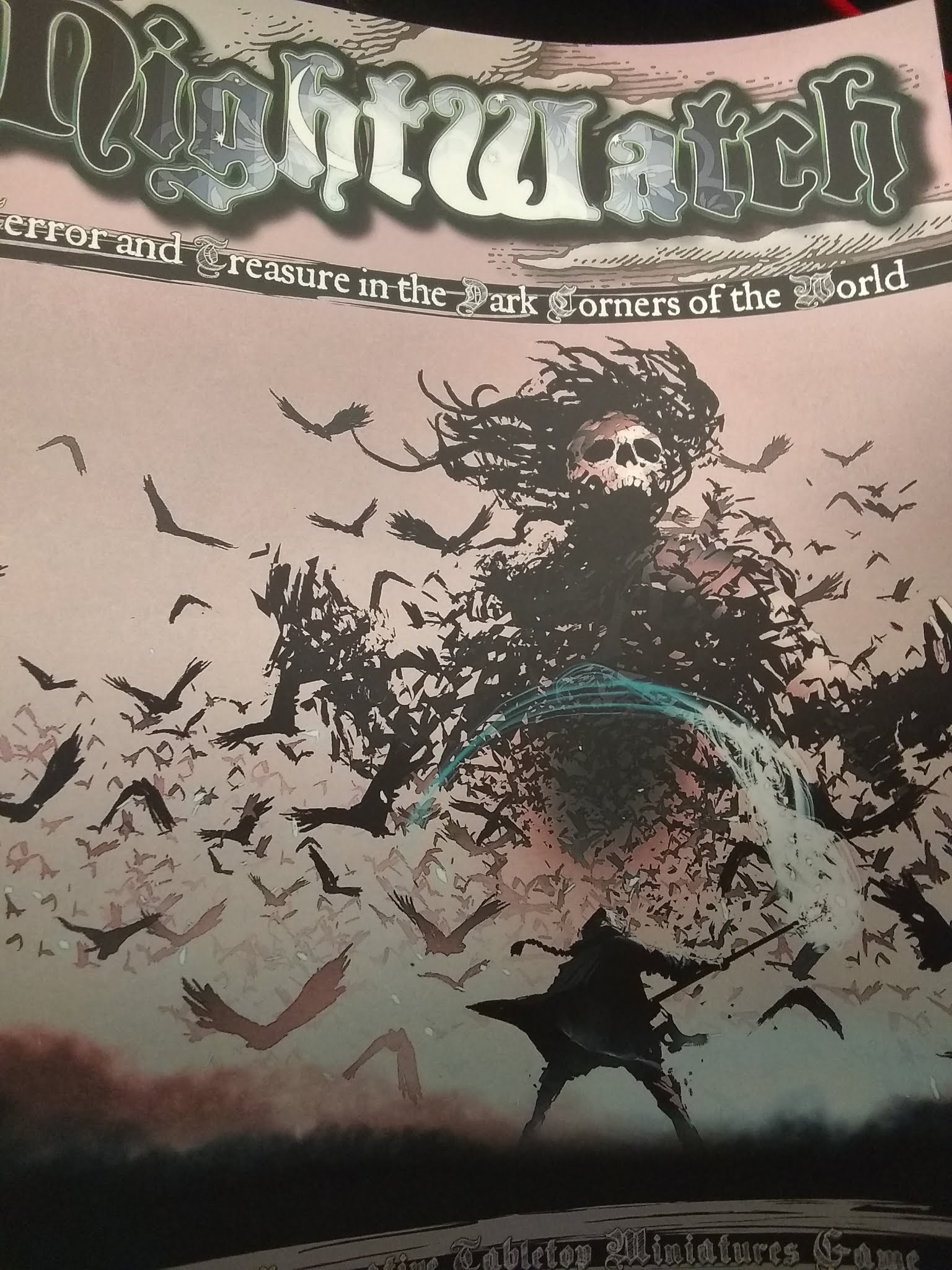
Nightwatch - Spawn Matrix

 Nightwatch: Terror and Treasure in the Dark Corners of the World has proven to be a delightful little solo wargame that has kept your host occupied for hours.  Almost four of them so far, and I'm finally starting to get the hang of all the basic rules.  One thing that I have found helps me need to remember less stuff is to prepare a 'reinforcement' table before the game begins.  Rather than refer to the table in the book and have to remember turn number and what my current difficulty rating is, I can just grab the next batch of baddies and go to town.

Take a look:


The numbers at the top are the turn numbers, the letters down the left hand side represent "Terrors", "Hordes", and "Vermin" from top to bottom.  Now, once my little Guildsters have completed their four actions on a turn, I can just reach over and grab the next column of reinforcements.  This also gives me a solid 'turn counter', because I can just look at the blank columns and know where I am at in the current game.

Here is some tabletop eye candy showing a scrum as four heroes defend the bones of a fallen saint against the ravages of lizardmen:


And if you want to get your hands on a copy for yourself:

Thursday, March 11, 2021

Nightwatch: The Solo Wargame


This is a game about killing monsters. All kinds, anywhere, any time.

So speaketh Patrick Todoroff, the scribe behind Nightwatch.  

This little gem of a wargame is a solo wargame that features a fairly simple core mechanic upon which you can bolt all kinds of weird and wonderful special rules.

The short version is that you take four heroes onto a table filled with terrain and have to accomplish one of the standard wargame objectives. Break a thing. Cross the table. Find a hidden thing and get off the table. That sort of objective. The trick is that there are four spawn points where increasingly strong monsters are going to be pouring onto the table to stop you.

The core mechanic is that each figure gets four actions: a free move and three potential interactions. You've got to roll above a target number of 4+ to succeed. You get one each of the d6, d8, and d10 with which to try and take actions beyond that free move, and that's the core. Each character class gets two things it's good at, and so it can roll two dice looking for a success. Tanks get to roll two dice in melee and resisting damage. Wizards get to roll two dice when casting a spell or moving.

The enemies that spawn on the table have four classes as well. All get a free move and then they scale up in actions from a single d6 to a pair of d8s to three d10s. So each class grows in power exponentially. From one action to three per turn, and an increasing probability of moving and striking, it gets pretty tough. The last class is the big Big Battle, and that last boss has multiple wounds, multiple abilities, and four actions per turn, making it the end-state goal of a seven-plus mission quest.

If it all sounds a bit generic so far that's probably because it is, but that's all part of the beauty of the system. It's meant to be a starting point for you to use your own figures to really make the game come alive.

Got a giant bat swarm? Fine - they are vermin who who fly over obstacles. A minor threat, but one that can zip freely around the table.

Got skeletons? Give them a +1 to resist damage from bladed weapons.

Got a dragon figure? Make it the Big Boss and give it fire breath, flight, and ferocity. It'll make for a serious threat.

It's a refreshingly open game system, and one that looks robust enough after a couple games to allow for just the sort of tinkering that every wargamer does anyway.

Highly recommended.

Thursday, March 4, 2021

Nightwatch Roster Sheet


My first Nightwatch.

Since nobody else is going to do it, allow me.  If you're ready to play Nightwatch, a solo fantasy skirmish game by Stalker7, then you're going to want to use a more compact and efficient character sheet than those in the book.  They are fine.  They get the job done, but they take a full page to do what could be done in a quarter page.


You can either save that roster above and print four to a page using the "3.5-inch by 5-inch" setting on your printer, or print one to a page four times.


[EDIT: On March 15, 2021, I changed this roster sheet to make it more workable at the table.]

Tuesday, March 2, 2021

Nightwatch: The Solo Campaign

So I ordered a copy of this based on the recommendation of a viewer over on the channel, Justo Perez, and it's been a real struggle to read.

Not because of what's in it, but because life is hammering away at me with reckless abandon.  Not sure why, but every time I grab this book there's an emergency that drags my attention away.  Very strange.

And disappointing, because there's some real potential in this book.  It's a smallish skirmish game that looks designed to be played by a single player.  You would think that could be said most skirmish games, but we live in strange times.

You'll take two to four heroes, each of which has stats a bit less complicated than what you'd find in a Warhammer Quest style game.  They look to be more on par with what you see in Frostgrave, which is nice because you can also plug in a handful of less powerful and hence less-complex allies.

Then you've got to handle the hordes of enemies, whose stats are (mostly) single dice.  The bigger named entities stand out with more actions and more special rules that complicate matters, but it still doesn't look unmanageable for a single player. 

We'll have to play through a game or two to know for sure.

For now, I really like what I see.  It's specific where it needs to be specific, vague where it needs to be vague, and just open-ended enough to allow for some exploration.  And how about that tagline?


In a grimdark world where everyone is falling all over themselves to wonder who are the real bad guys, where Disney keeps trying to explain that witches are cool, actually, and literal satanic pedophiles exercise global power, it's nice to find a game that admits...

It's the monsters.
Monsters are bad guys.
Go kill them.

More to follow after this game meets the tabletop.

Wednesday, February 10, 2021

John Lambshead's One-Hour Skirmish Wargames

If these games take a full hour, it'll be a surprise.

In this slim tomb, a full and more detailed review will follow over at the Joy of Wargaming later this month, Mr. Lambshead presents a bare-bones skirmish system suitable for 12-30 miniatures.  Mr. Lambshead takes that system and then polishes it up with six period specific additions, each of which will allow you to add conflict-specific flavor to your skirmishes.

In a break with modern gaming, and perhaps as a bit of a throwback to ye olden tyme wargameing, the rules eschew the use of dice.  Instead, each player utilizes a deck of cards for initiative and action resolution, with Jokers signaling the end of the turn.  After a quick shuffle, the top cards are flipped to determine initiative, after which players alternate drawing cards to determine how many actions they can take on their phase of the turn.  The value of the action card determines how many actions the player may take with as many models as he chooses.  A ten, for instance, would allow ten models to make a signle move or five models to move twice or perhaps to move then shoot.  It's a quick and robust initiative system that leaves room for some flow without the interminable wait for a more standard IGO-UGO system.

The conflict resolution is a simple card comparison.  In a fight the two models draw cards and the high draw wins.  Likewise with shooting, with model skill and cover allowing for more than one card to be drawn.

The game includes a morale system as elegant and speedy as initiative, melee, and shooting.  And as the years roll on the weapons get bigger and more deadly.  So too does the addition of models drastically affect the game.  As with everything else in these rules, vehicles are played fast and loose with an eye toward minimal book quick resolution rather than an extreme fidelity to real-world odds.

One-Hour Skirmish Wargaming is a tight little ruleset, and one written for the casually serious wargamer.  The use of cards and a loose trust in the player's ability to fill in the gaps makes this a very old-school style of wargame rulebook, and a welcome addition to my own personal bookshelf.

Saturday, October 10, 2020

On the Table at 2mm

With the painting out of the way, let's take a look at what 2mm figures look like on the table.

But first, here is a side-by-side shot of the Great Traffic Light Alliance, with British on top and Austrian in the middle and Russians on the bottom row.

Any serious wargamer would chafe at the oddities of these line infantry.  Any wise wargamer would understand that the pieces are representative - we're going to be using these guys for everything from the Marlborough Ear to Seven Years War and maybe even a little Napoleonics.  That's a pretty wide swath of history that saw a lot of refinements in battle field tactics.

My armies are hampered a little by the decision to purchase army packs that work great for one specific era.  Using them for a broader than intended sweep means sacrificing purity for flexibility, a sacrifice that I am willing to make for the cause of good gaming.

And here is a good shot of how easy it becomes to recognize friend from foe on the table.  Ignore the massively out of scale roads.  (It makes me smile to think of 6mm terrain as way too big.)  Instead, note that the Austrians and Russians are easy to tell apart.  So too with the difference between cavalry and line infantry, with even a little cannon holding the giant crossroads easily distinguished by its unique appearance.

While I'm not yet a 2mm supremacist, this project has been very fulfilling.  It's a new scale for me, and the game scale - full Corps represented by around 20 elements - offers new challenges and a fresh approach to big battles over that of the usual "Rank and Flank" style games.

Don't be intimidated by their size - these guys are great.  

All my figures to date are from Irregular Miniatures.  They don't have a massive line of figures, but it's the biggest around (heh) and at this scale figures are extremely flexible.  It wouldn't be much of a stretch to choose some fantastic colors and name the blocks shown above as orcs or elves!


Friday, September 18, 2020

What Are The Odds

 Prolific YouTube commenter Andrew Beasely had a great question on my solo play of Osprey's En Garde!


To bring you up to speed: in this game each melee figure gets to enact a set number of ploys.  Better fighters get more options.  The players each take a number of tokens that corresponds the figure's rank.  To complicate matters, the player has to choose how many will be attack and how many defense.  The players do this in secret and reveal their attack-defense ratio after both have selected, enabling a mini-game of bluff and counter-bluff.

My solution was to draw beads randomly from a bag, but Andrew makes a great point.

One of the reasons my games played so wonky is that I would draw beads from the same bag.  Think about what that means for each combat.  My fighters were balancing each other out!

Let's use an example to illustrate the problem:

  • The bag contains ten of each bead, attack and defend.
  • Two Rank 5 figures are going to fight.  The first one draws four attack and one defend
  • Now the second fighter isn't drawing from a 10:10 bag, he is drawing from a bag that has six attack and nine defend
  • The second fighter is more likely to draw the opposite of what the first one does, resulting in very even fights with few all out matched attacks
What I need to do is get a second bag with the same mix of beads.  That way both fighters are drawing from the same ratio pool as the other.

Man, I should have started The Joy of Wargaming a long time ago!

Wednesday, September 9, 2020

More Vendeean Eye Candy

Been playing around with Osprey's En Garde! while waiting for the Big Battalions package to arrive, and it's been nice to fiddle with a new ruleset and some blackpowder scenarios.  My fantasy town works well as a backdrop if I leave off the wizard tower and skull mountain pieces.

The game doesn't work all that great as a solo game, what with a big part of the combat requiring some bluff and counterbluff.

Random draws for combat ploys often results in pointless rounds of combat where not much happens.  That happens in two player games as well, to be fair.

In the first battle fought, the press of numbers proved overwhelming with two Rank 2 figs supported by five Rank 1 figs dominating a team composed of a single Rank 3 and four Rank 2 figs.  It also included the usual first volley bloodletting followed by everybody charging straight into melee.  A completely historical result if my years of Hollywood movies are to be believed.

Tuesday, August 25, 2020

It's a Riot!

 Matt Hartley's Riot!  Revolting People from Watt Tyler to Watts is an interesting wargame.  It's a truly fourth-generational game in which mobs of outgunned citizens try to effect change against a far better armed, but outnumbered, army of the ruling class.

Enjoy some eye candy while I pontificate.  Alert readers will notice that I've put a grid over the tops of these buildings.  In Riot! the mobs can loot and burn structures, but each counter only affects one square inch at a time.  Mine are a little less regular than the rules stipulate, but they'll work just fine.

Definitely a beer-and-pretzels game, it uses a simple AI to maneuver the rioters about, and the player tries to limit the damage with his small number of security forces.  The first check on the player is an AP roll of 1d6, each pip of which allows one unit to move or attack.  That makes it harder to split your forces because it limits how many stands you'll be able to use from turn to turn.

Combat is a simple 2d6 roll off for each matched pair of bases, with a few modifiers for supporting units or flank attacks on the mob or for weapons hot.  It's quick and dirty, and the cops don't have nearly the advantage one might expect.

It turns out the better tactic for cops is to simply stand off and try to herd the mobs away from their targets.  You can exert some control over the AI - or at least influence outcomes - by staying close to a mob, but not directly engaging unless you really have to.


Which leads to a very fluid game, and from all I've seen on TV these days, pretty well mimics the ebb and flow of protests in the streets.

More to the point, the game is a lot of fun, and can provide some insights into a warfare of a very different sort.