Tuesday, January 5, 2016

Small Box Blues, Part Two

There are basically two ways to build wargame interiors.  You can place freestanding walls on a ground surface (aka "the maze"), or you can integrate them into the ground surface (aka "tiling"). There is a third way, a hybrid method with tiles that represent rooms and corridors.  Let's look at each in turn.

The maze gives you a lot of flexibility at the cost of visual appeal.  The walls are left generic so that they can represent anything; any specific feature that draws attention to the purpose of the room limits your flexibility.  Furniture scatter terrain serves that purpose.  A stove marks the galley, a bed marks the bunk, and a command chair marks the bridge.  A standard assumption of the maze is that the perimeter of the drop cloth actually represents invisible walls.

In practice, there is little to distinguish the maze from an outdoor setup.  You've got a rectangular battlefield with large terrain pieces scattered about that influence your decision making process.  The terrain may be linear walls instead of blobby buildings and woods, but you're still playing on a plane surface broken by impassable terrain.

Tiling gives you the ability to designate spaces by purpose.  Now, in addition to the stove, you've got a menu and cabinets line the walls, and the command chair faces large viewing portholes.  You get a much more appealing look at the cost of flexibility.  You also gain fully visible exterior walls, further marking the gamable space as firmly "inside".

A tiled battlefield feels very different from the maze.  It's more claustrophobic as everywhere you turn, there's another wall.  You wind up thinking more in line with real world interiors ("Better send three guys through the garage bay to flank them through that dining hall.") than you do with a maze.  The game play might be similar, but having real world features helps turn things from a gladiator arena to a living space.  It changes both the aesthetic and the game play.

So if you're looking for an actual interior, it's well worth it to create actual tiles.  Which would bring us back to my new box set, but before we do that, let's look at a couple of cool hybrid strategies implemented by other bloggers.

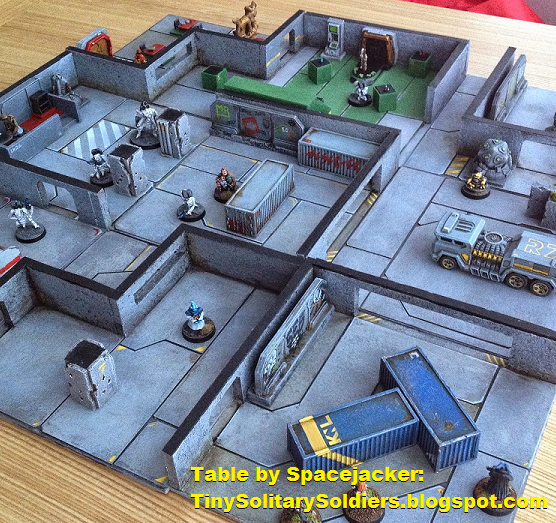
Spacejacker built a blank tile set with themed scatter terrain.  It's an elegant solution which allows for a lot of flexibility, while capturing the interior feel.
Delta Vector's solution was to build individual rooms, but place them on top of a drop cloth.  Those corridors still look and feel like an interior, but he can personalize each room.  Plus, gains the stackability of the rooms, allowing him to pack more terrain into a smaller box.  Again, a very clever technique.

Stalker7 built a maze on top of tiles.

There are a lot more clever ideas out there, but that gives you some idea for how smart people approach this situation.  Next time we'll look at how a dumb person does it.

Monday, January 4, 2016

Small Box Blues, Part One

How do you cram as much gamable space as possible into as small a space as possible?  We're going to kick 2016 off with a week-long series of posts introducing my solution to one specific kind of terrain.  Specifically, a solid set of sci-fi interiors that are attractive, provide a wide variety of battlefields, and allow room to reach the figures.  First though, let's establish what we mean by gamable space.

Any place that a figure can move to or shoot through is part of the gamable space.  The most common limits to gamable space are marked by the edge of a ground cloth, which can be fabric, foam, or even the edge of the table.  Sometimes we limit gamable space within those out boundaries by placing 'no-go' areas like the space between halls and rooms in a dungeon or space hulk, or impassable terrain like mountains or un-scalable buildings.  If the game can't go there, it isn't gamable space.

That is a central concept so tied into the game that we never really think about it beyond answering the questions of how much space do you need, and what happens when a figure leaves that space. It takes on significantly more import when you are trying to get as much of that space into as little storage space as possible.  And that's the subject of today's post.

The arbitrary and artificial limitation that I have placed on my gaming, that a full set of terrain must fit inside a smallish box, makes things challenging.  Gaming primarily in 15-mm skirmish settings eases that pain a bit; you only need to build up enough terrain to cover two- to three- foot squares of real estate.  That still leaves you with a situation where space inside the storage box is at a premium.

One solution to this are as old as gaming itself.  Namely, throw in a drop cloth of the right size and five to ten pieces of scatter terrain such as buildings, roads, forests, and hills.  It works great - you get a big space with a lot of variation with very little space investment.  I took this classic approach with the first big box set.

I don't think I've ever showed how my sci-fi battlefield
all packs up into one small box.

Even with the dedicated roadways limiting terrain placement, there are still countless ways to vary the setup.  You can even block those long firing lanes with appropriate scatter terrain such as vehicles, concrete traffic barriers, and makeshift barricades.  The possibilities are limitless.  With a ground cloth that is roughly two- by three- feet across, you always get six square feet of battlefield.


That box is roughly 6 by 8 by 10 inches
For my next set of terrain, I bought a the storage box manufactured to hold two sheaves of writing paper.  As a result the box measures eleven by nine inches with a height of six inches.  It's a little bigger than that, actually, but we need some wiggle room lest we damage the terrain in storage.  So let's consider the floor to be about two-thirds of a square foot (99-square inches) of real estate.

The theme of this next terrain set would not consist of another outdoor drop cloth setup - we already have one of those.  This time around would be an interior setup, or at least something similar.  The challenge with interior setups is that pesky third dimension.  Now you have to consider how tall to build your walls, and that limits the horizontal space.  You can fold up a drop cloth and cover up to twelve box footprints (eight square feet of battlefield) in just an inch or two of vertical space, with plenty of space left over for set-piece and scatter terrain.  If your interior tiles have walls an inch high, you can only fit six tiles (four square feet of battlefield) with no room left over.

My initial thought was to build a series of nesting rooftops.  Back in early November I shared a couple of photos of the first phase of my new box set of terrain. By nesting the rooftops inside each other, you're looking at four pieces of terrain, each about nine by eleven, that fit together to give you about 2.75 square feet of gamable space.  You can extend that a little by not butting each right up against each other.  The alleys between are still gamable - you can shoot or even leap over them - but now you've got four islands and a lot fewer lanes for movement.  Goodbye flexibility, hello overwatch!

We can do better.  But how?

Tomorrow we'll look at some possible solutions, including a few clever ideas from my fellow wargame bloggers.

Sunday, January 3, 2016

Tyranny of Dragons, Session 14 - Carnath Roadhouse

After a brief rest amid the splendors of Waterdeep, our plucky band of heroes found themselves heading north once more, once again disguised as humble guards protecting Dragon Cultists who were disguised as a humble road construction crew.  The Lords of Waterdeep had set out to repair the long abandoned north road, which used to allow passage through a massive swampy mire.

On the road to the roadhouse, the party came upon a large stretch of roadway filled with quicksand. This sort of thing had happened a few times along the road, which did pass through a swamp after all.  Skirting the edge of the quicksand, the party quickly learned that this quicksand was dug by bullywugs who had cleverly lain in ambush.

The surprise was total, with the necromancer Gilgamesh taking a beating, outnumbered by the slimy creatures.  At one point he was down to his last death save.
Wizard down - scramble the medics!

But no one could get to him, everyone locked in savage melee with the remaining bullywugs.

Fortunately, his death saves went well, and he managed to stabilize before bleeding out.  Once the rest of the bullywugs and giant frogs were dispatched, the medics patched him up toot sweet.

They had freed lizardman slaves, fought an army of undead, fought through bullywug ambushes, and now finally found themselves at a safe rest-stop: The Carnath Roadhouse.

Let's just pause for a moment to get the Patrick Swayze jokes out of the way once and for all, okay?

Everybody done?  Good.

The Roadhouse was a rough structure built on the only dry patch of land for miles, and served as the construction hub for the project.  Poking around a bit, the party found a secret basement, with a long tunnel that lead off into the swamps where it emerged...right in the center of a kobold work camp! Clearly the work of the Cult of the Dragon.  The noise and approaching light of the party had warned the kobolds, who set about defending their camp with a fervor based more in faith than in skill.  The fight was short and bloody, but two kobolds escaped to warn...well, the party wasn't about to wait to find out.

Hurt, wet, muddy, with their cover blown and with their resources depleted, the party elected to move off a ways into the swamp and camp to rest and recuperate.

And that's where we left the session.  That's also where this narrative trails off.  Your humble blogger has two too many irons in his fire right now, and the D&D sessions are going to have to take the hit.  As you can tell from the increasing infrequency of this portion of the blog, it's been getting harder and harder to make the sessions.  Rather than string the group, and you, along, it's time to put this story to rest.


Saturday, January 2, 2016

A Tree Grows in Neo-Brooklyn

Four trees, actually.  Nine more pieces of scatter terrain - what the cool kids are calling street furniture these day - have been added to the table for cover.


When it comes to small bits of raw material for scratch-building, the electric aisle of your local hardware store is your friend.  Today's project consists of nine planter boxes.  The larger tree planters started out as six roughly one inch diameter plain wooden disks purchased at the craft store.  Two of them were double up to give a slightly taller planter box, and then the four metal washers were glued on top of those.  They come in a wide variety of diameter and height, so you can pick and choose just the right ones for your terrain - they make sizes that would work just as well for the big 25's.


The smaller plastic nuts are used pretty much as-is.  Each had some molded ID's on top that needed to be trimmed off, then a small disc of cereal package cardboard was glued up underneath the inner lip of the threaded part. 

The actual trees were plastic Toob Trees left over from previous projects, glued in place with PVC glue.  After drying, the inside of each planter was covered in craft glue and fine sand for a decent earthen texture.


The whole lot was painted in one fell swoop.  After painting, the ground covering plants were added.  The bushes are standard modelling fluff you can find at any decent hobby shop, and the flowers cheap plastics off a $1.50 strand.  

Ta-da
In the end each planter cost about a dollar each, and the whole lot was assembled in an hours, base coated and allowed to dry overnight, and then painted and table-ready in a second one hour session.

The concrete of the planters was painted to match the surrounding buildings, and the flowers given a suitably alien blue and purple hue. The foliage could have been painted to match, but I'm looking for a near-earth parallel here, not an over-the-top cartoonishly alien planet.

Here's what they look like on the table.


Friday, January 1, 2016

And Now a Word From These Sponsors - Ad Boxes in 15mm


Last year was the year of the One Hour Wargames Big Box.  This year is going to be the year of sci-fi scatter terrain, with some digressions into 15mm fantasy wargaming, and hopefully more games on the table.

To kick things off right, here's my take on advertisement boxes for 15mm sci-fi - an idea shamelessly stolen from this thread.  Unlike surprize in that thread, I picked up the two clear plastic boxes from the bead section of the local craft store for two bucks each.  They have a variety of sizes, so you should be able to get the same boxes sized right for 28-mm figures, too.


I glued squares of card stock painted black to the roof of each, to cover up the mold lines there. At some point I'd like to experiment with a small LED inside, but lighting terrain is one of those things that always struck me as an in for a penny in for a pound proposition. A fully lit table is a joy to behold, one piece of lit terrain draws attention to the darkness of the rest of the table.


Here's the image that was used  to print up the ads themselves.  These were all stolen from various sources around the interwebs, cut and polished up to look as decent as possible in the boxes.


Thursday, December 31, 2015

The Sci-Fi Table: Before

As we leave 2015 behind, let's look ahead to the coming year.  The blog's focus heading into the New Year is going to be stuffing as much scatter terrain into the sci-fi box as possible.  Right now the sci-fi table has the necessary big structure to it, but is woefully lacking in the minor bits and bobs to provide that all important cover in modern+ games. See for yourself.  This is the table set-up as it currently stands.


Not bad, a bit pulpy, and not the sort of thing to complain about, but here at the Abox household we've never been ones to rest on our to-scale laurels.  This year we're going to fill in a lot of gaps with benches, planters, sculptures, more vehicles, and whatever else will fit in the box.  Once we do, we can move those farm fields off the table and into the fantasy genre where they fit so much better.

Did I mention we'll be starting a fantasy table, too?  Unlike last year's total focus on a Big Box of fantasy mass battles, this year we are diversifying to start up a fantasy collection.  This will be a total package Big Box, with all the fittings.

Oh, and more playing of the games.  We'll squeeze that in, too.  At some point we'll take a shot of the updated sci-fi table so you can see the difference in aesthetics and playability that a lot of little touches can make.

It's going to be a busy year, so update your blog-rolls and RSS's and bookmarks.  Should be a lot of fun, too.

Tuesday, December 29, 2015

The Podcast We've Been Waiting For

If you're one of those poor bastards that grinds through a long commute on a daily basis, then you can't get enough decent podcasts.  There are a hot steaming pile of them for tabletop RPGs, a few of them are even worth a listen, but very very few for tabletop wargaming.  Those that exist for wargaming are mostly dedicated to the big production house games like 40k and...I don't know, Infiniti?  I'm a 15mm guy who loves himself the boutique publishers, so you'll have to find the big boys on your own google-time.

But if you are also a boutique style 15mm wargamer languishing in the wilds of a fairly obscure corner of this fairly obscure hobby, then there is finally a podcast just for you, for me, and the rest of our tiny little clique - In the Garage.  It's run by the guys at Clear Horizon Miniatures, but the first podcast takes a nice spin around the genre with positive mentions of Osprey rules, GZG, and a fair few others.

After one episode, I can't tell you the names of the two hosts off the top of my head, but they are fun guys who take things just as seriously as they deserve.  Wait a second, that's not entirely true; Mister Harold, who you may know around the net from the Lead-Adventure Forums is one of the hosts.  If you know him from around the net, then you know he is both knowledgeable, friendly, and enthusiastic.

You should give it a listen.  For my part, I'm looking forward to hearing more episodes in the future.